Space Economy Weekly — Apr 23, 2026
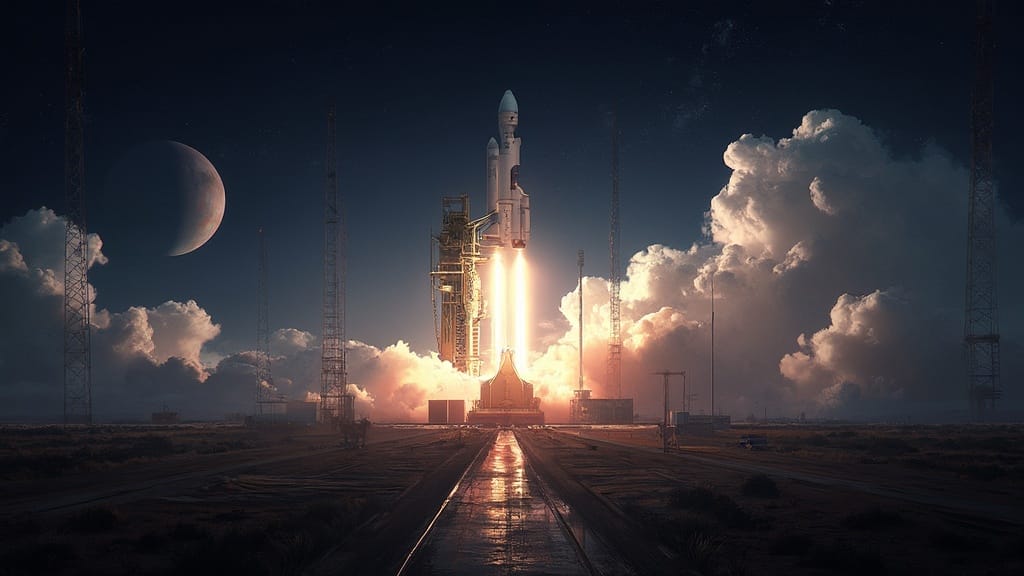
Photo: lyceumnews.com
Week of April 23, 2026
The Big Picture
This was a week where paperwork did more work than rockets. The FCC greenlit AST SpaceMobile's 248-satellite direct-to-phone network, the House quietly gutted the Senate's safeguards on satellite licensing, and China's state-owned banks committed $8.4 billion in credit to an orbital data center startup that hasn't flown its demo satellite yet. Meanwhile, NASA's Roman Space Telescope is — astonishingly — under budget and ahead of schedule, Japan's H3 is rebuilding toward a Mars window it cannot afford to miss, and Amazon Leo is 241 satellites deep into a 1,618-satellite regulatory deadline arriving in July. The physical hardware is catching up to the filings, but not fast enough, and the filings are what determine who gets to exist.
What Just Shipped
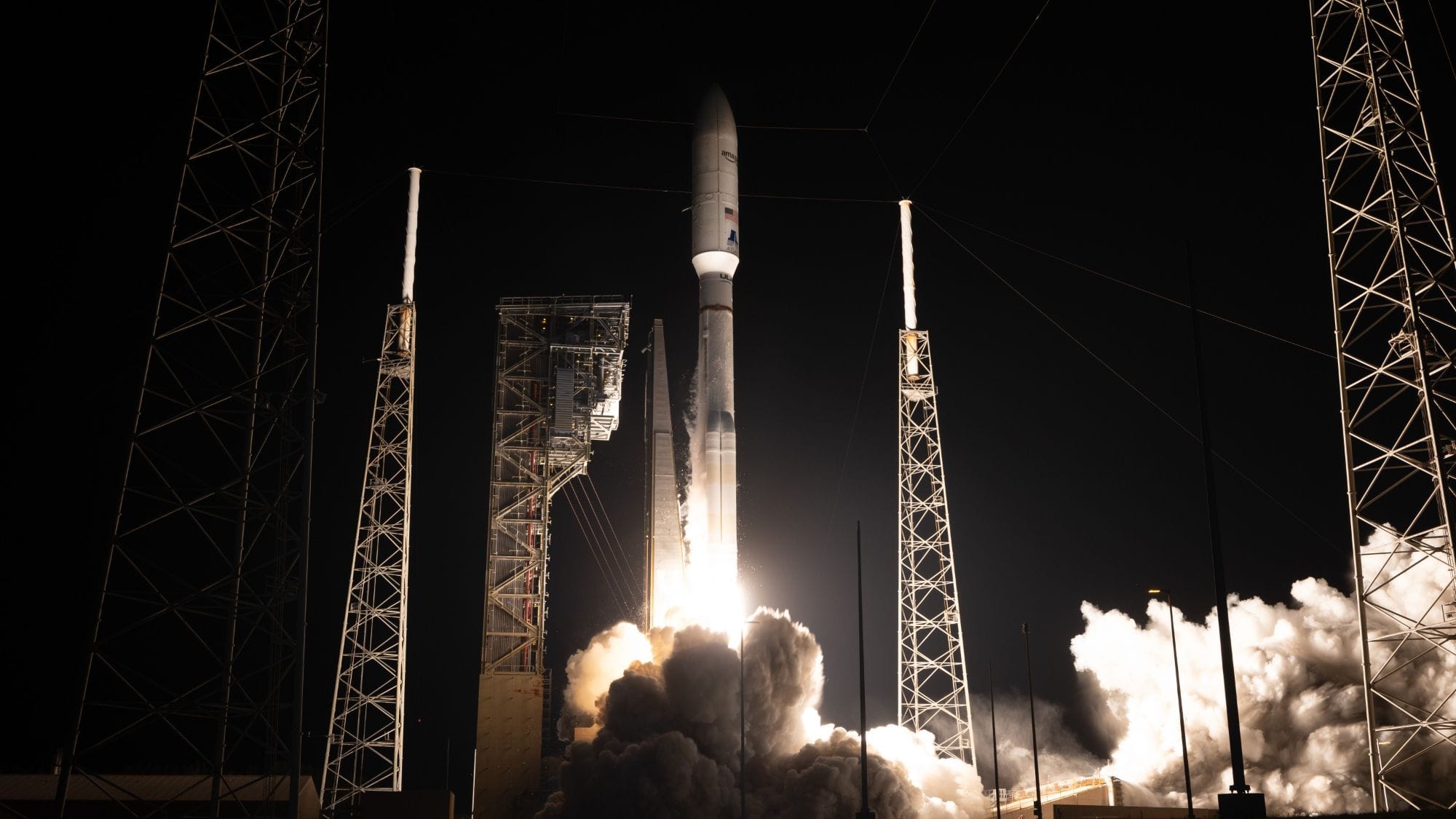
- Amazon Leo LA-05 (29 satellites) (ULA/Amazon): Heaviest payload ever flown on an Atlas V, bringing Amazon Leo's on-orbit count to 241.
- Innovative Satellite Technology Demonstrator No. 4 (JAXA): Eight small satellites launched April 23 from Tanegashima — JAXA keeping its small-sat cadence alive while the H3 investigation continues.
- HTV-X1 free-flying phase (JAXA): After undocking from the ISS, the cargo vehicle is now operating as an independent technology demonstration platform — cargo-as-testbed as a new economic model.
- AST SpaceMobile FCC license modification (FCC/AST): 248-satellite authorization, including 223 satellites for Supplemental Coverage from Space in 700/800 MHz bands.
- Blue Origin New Glenn NG-3 mission (Blue Origin): Third New Glenn mission targeted no earlier than April 19 from LC-36 — the cadence test begins.
This Week's Stories
China Bets $8.4 Billion on Putting Data Centers in Orbit
The headline number is big. The signers are bigger.
Orbital Chenguang, a Beijing-based startup, announced strategic credit lines totaling 57.7 billion yuan ($8.4 billion) from 12 major Chinese financial institutions, including the Bank of China, Agricultural Bank of China, Bank of Communications, Shanghai Pudong Development Bank, and CITIC Bank, per SpaceNews. These are China's largest state-owned banks — not venture funds. Orbital Chenguang is incubated by the Beijing Astro-future Institute of Space Technology, itself backed by Beijing's municipal science and technology commission and the Zhongguancun Science Park administration. This is industrial policy dressed as a startup round.
The pitch: sun-synchronous orbit offers near-continuous solar power and passive thermal rejection, theoretically enabling compute workloads that would be prohibitive on the ground. A phased plan runs 2025–2027 for core tech and first constellation launch, then 2028–2030 for integrated ground-and-space compute.
If it works, China has a parallel, state-underwritten AI compute architecture that is harder to sanction and that could bypass domestic power-grid constraints now bottlenecking terrestrial data centers. If it doesn't, the $8.4B is a credit line, not committed capital — drawdowns require milestones. The observable signal is Chenguang-1, the demo satellite slated for late 2025 or early 2026 that, per SpaceNews, does not appear to have launched. Until that flies and survives its first thermal cycle, the financing is ahead of the physics.
Japan's H3 Is Rebuilding — and a Mars Mission Depends on It
On December 22, 2025, JAXA lost the Michibiki No. 5 navigation satellite when the 8th H3 flight suffered a second-stage anomaly, per SpaceNews. JAXA's investigation, reported by SpaceEyeNews, found damage to the satellite mounting section during payload fairing separation and damage to second-stage fuel tubing that likely caused early combustion cutoff. It was the second H3 failure in eight flights — both upper-stage — following the March 2023 debut loss.
This week, Japanese industry reporting confirmed the new H3 "Type 30" configuration (three LE-9 engines, no solid boosters — the lowest-cost variant) has completed combustion testing and is headed to final testing for a launch within the Japanese fiscal year. Mitsubishi Heavy Industries is targeting roughly $37 million per launch for the Type 30.
If the return-to-flight holds, Asian satellite operators get a credible Falcon 9 alternative for medium-class payloads, and the Martian Moons eXploration mission — scheduled for a November–December 2026 launch window — gets to fly. If it slips, MMX misses its Mars window by roughly two years, and Japan's planetary science program spends the decade watching. Watch for JAXA's formal return-to-flight announcement and the Type 30 maiden flight date.
Amazon Leo Has 241 Satellites and Needs 1,618 by July
The most consequential deadline in commercial space right now isn't a spectrum ruling. It's a satellite count.
Under its FCC license, Amazon must launch and operate roughly 1,618 satellites — half the constellation — by July 30, 2026. After the April 4 LA-05 mission, which deployed 29 satellites on the heaviest Atlas V configuration ever flown (per Space.com), Amazon is at 241 satellites across nine launches. That gap cannot be closed in the roughly 14 weeks remaining.
Amazon filed with the FCC in January 2026 to extend the deadline. That extension request is now the critical path.
If the FCC grants it — likely, given agency precedent on constellation milestone waivers — Amazon gets a realistic runway to compete with Starlink, and the broadband market reshapes around a genuine second entrant. If it doesn't, Amazon faces license complications that could affect its commercial rollout and force a restructuring of its $11.6 billion Globalstar acquisition thesis. The observable signal is the FCC's response to that filing. Everything else is launch theater.
AST SpaceMobile Gets Cleared for a 248-Satellite Direct-to-Phone Network
On April 22, the FCC issued order DA-26-391A1 modifying AST SpaceMobile's license to deploy up to 248 non-geostationary satellites, including 223 for Supplemental Coverage from Space, using 700 MHz and 800 MHz spectrum coordinated with Verizon, AT&T, and FirstNet. These are the low-band frequencies that made 4G LTE work in rural America — they punch through walls and travel long distances, which is exactly what you need when the ground terminal is a phone in someone's pocket.
If AST executes on the deployment cadence, it has regulatory runway to become genuine emergency backup for FirstNet — the nationwide public safety network — and a structural competitor to Starlink Direct-to-Cell. If not, the license is permission, not traffic: handset behavior, interference management, and manufacturing cadence are all still unproven at 248-satellite scale. Watch the launch manifest and the first live FirstNet interoperability test.
The House Version of the SAT Streamlining Act Drops the Senate's Safeguards
The satellite permitting bill unveiled in the House this week — and heard by the House Energy and Commerce Subcommittee on Communications and Technology on April 21 — does not include the Senate version's provisions on federal spectrum or a cap on the size of constellations eligible for automatic approval after a review deadline expires, per Roll Call.
Translation: under the House text, if the FCC misses its one-year clock, a license could be deemed automatically granted — with no size cap on the constellation that gets waved through.
Context matters. Per Roll Call, SpaceX has applied to the FCC to launch up to 1 million satellites for a data center project. Per Legis1, Planet Labs reported more than $1 million in lobbying on commercial space regulation across four quarters; Iridium reported $320,000 on satellite and spectrum licensing.
If the House version prevails, the FCC loses meaningful vetting power over mega-constellations — the backlog becomes the policy. If the Senate safeguards survive reconciliation, review timelines get funded and the size cap stays. The bill is pre-markup, so the text will shift. Watch the markup schedule and whether the House adopts the Senate's cap language.
NASA Moves Roman Up — and Hands Falcon Heavy a September Launch Slot
On April 21 at Goddard Space Flight Center, NASA announced the Nancy Grace Roman Space Telescope is now targeting launch as soon as early September 2026, ahead of the agency's no-later-than May 2027 commitment. The $4.3 billion telescope will ship to Kennedy in mid-June for integration on a Falcon Heavy, per Scientific American — and, remarkably, Roman is under budget and ahead of schedule.
The political subtext is the story. Per the Nancy Grace Roman Wikipedia entry, the second Trump administration's FY2026 budget draft proposed cutting NASA's science budget from $7.5 billion to $3.9 billion and canceling dozens of missions, Roman among them. You don't cancel a telescope that's already on the pad.
If the September date holds, Roman becomes the proof case that fixed-price commercial launch contracts and tight payload schedule discipline actually work — and it consumes a premium Falcon Heavy slot that tightens Florida's heavy-lift manifest. If it slips, the 2027 fallback gives critics of NASA's science program management new ammunition and reopens the cancellation fight. Watch the June shipment to KSC.
A French Startup Wants to Put 5G in Very Low Earth Orbit
Per SpaceNews, French startup Univity raised roughly $32 million in Series A funding to deploy a pair of 5G demonstrators into very low Earth orbit next year — altitudes typically below 450 km, where atmospheric drag is significant enough to require continuous propulsion — ahead of plans for at least 1,600 VLEO satellites to extend terrestrial telecom networks from orbit.
The VLEO pitch is physics-driven: lower altitude means lower latency and smaller ground terminals, potentially letting unmodified 5G handsets connect without the link-budget gymnastics that direct-to-phone LEO services require. The tradeoff is that drag demands continuous thrust, which adds mass, cost, and a finite propellant life.
If the demonstrators validate the propulsion and link-budget assumptions, Univity opens a market segment between LEO broadband and terrestrial 5G that Starlink and Amazon Leo aren't targeting — and European telecom operators get an orbital layer they can integrate without handset changes. If the drag math doesn't close, the constellation economics collapse. Watch the demonstrator launch date and the first independent link-performance measurements.
⚡ What Most People Missed
China's orbital compute is a sector-level industrial strategy, not a single startup story. Per Science and Aerospace, ADA Space and Zhejiang Lab launched 12 satellites for the Three-Body edge-computing constellation in May 2025, and Shanghai Bailing Aerospace Technology recently secured early-stage funding for a demonstration satellite targeting 100 kW-class compute. Multiple state-backed entrants and coordinated financing complicate the idea that targeted sanctions could neutralize a single company.
HTV-X1's post-ISS life is an economic innovation hiding as an operations note. JAXA's decision to operate HTV-X1 as a free-flying technology platform after undocking, per the NASA press release, turns an expendable resupply vehicle into a multi-month in-orbit testbed. One launch, two revenue streams. If other cargo providers copy the model, it compresses the cost of flight-proven tech demonstrations and reduces demand for dedicated small-sat buses.
The FCC's EPFD vote on April 30 is a bigger deal than the fact sheet suggests. Per the FCC's DOC-420708A1 fact sheet, the Commission is preparing to replace late-1990s Equivalent Power Flux Density rules — the downlink power limits that protect geostationary operators from LEO interference. GEO incumbents are flooding the International Bureau Filing System with ex parte submissions seeking delay. Spectrum rules are product rules in disguise; this vote determines how much real throughput Starlink, Kuiper, and AST can deliver.
FAA license revisions are doing the quiet work of scaling cadence. Per the FAA's published revision history, SpaceX's Falcon 9 Vandenberg license has been amended repeatedly to add mission categories — Starlink Group 7, Group 7 Dogleg, Group 8 — without re-running the full licensing process. Part 450 was meant to turn bespoke filings into an expandable operating model. These dry documents are what that looks like in practice.
Europe is building the return leg of the in-space economy. Per SpaceNews, German startup Atmos Space Cargo raised €25.7 million ($30.1 million) to fly a series of reentry vehicle missions. The in-space manufacturing bottleneck isn't getting experiments to orbit — it's getting the results back down affordably. As the ISS heads toward retirement, whoever owns the loading dock owns leverage across the entire sector.
📅 What to Watch
- If the FCC grants Amazon's July 30 deadline extension before June, it removes the structural threat to Amazon Leo's license and signals the agency will treat deployment milestones as more flexible for mega-constellation operators than previously assumed.
- If the House SAT Streamlining Act advances to markup without the Senate's size cap, expect an immediate surge of pre-emptive mega-constellation filings from operators racing to lock in priority before the rules tighten again.
- If Orbital Chenguang's demo satellite slips past Q3 2026, the 57.7 billion-yuan credit line becomes a political question inside China — state-owned banks do not typically carry zero-progress infrastructure debt indefinitely, even for strategic programs.
- If the FCC's April 30 EPFD vote goes the LEO operators' way, legacy GEO satellite operators' long-term enterprise contracts start looking like stranded assets, and expect litigation within 60 days.
- If Blue Origin's NG-3 flies in the coming weeks and Blue Origin announces a fourth New Glenn mission carrying disclosed commercial customers, the heavy-lift market finally has a credible second lane — and Falcon Heavy pricing pressure begins.
- If Roman ships to KSC on schedule in June, NASA quietly establishes a template for flagship science missions that survives the FY2027 budget fight.
The Closer
Twelve Chinese state banks signing an $8.4 billion credit line for a satellite that hasn't launched; Amazon staring down a July deadline it cannot meet with 1,377 satellites it does not yet have; and a Japanese rocket whose second stage has failed twice now sprinting toward a Mars window that opens in November and closes like a vault.
The paperwork is moving faster than the payloads — which is, historically, exactly the moment someone gets a deemed-granted license for a million satellites and nobody at the FCC remembers signing anything.
Watch the filings. The hardware will catch up, or it won't.
Forward this to the person on your team who keeps saying "it's just a rounding error" about Amazon's satellite count — they need to see the math.