Robotics & Automation Weekly — May 03, 2026
Photo: lyceumnews.com
Week of May 3, 2026
The Big Picture
The headline numbers are loud — Figure shipping one humanoid an hour, Tesla committing $25 billion, Schaeffler signing for 1,000 robots — but the more honest read is that the industry is busy with the unglamorous work of industrialization: pouring concrete, updating ISO standards, writing OSHA documentation, and arguing about who owns the orchestration layer. The production question is getting answered faster than the deployment question, and that gap is where this week actually lives. If you came looking for a single dramatic inflection, you won't find it; if you came looking for evidence that the trade-show era is ending and the operations era is starting, it's everywhere.
What Just Shipped
- Figure 03 (production ramp) (Figure AI): BotQ throughput moved from one robot per day to one per hour in under 120 days; 350+ units shipped per Figure's announcement.
- DualGear drive system (FAULHABER): Flatter drive profile engineered for space-constrained AMRs, letting integrators lower chassis height to slip under denser racking.
- Atlas (production version) (Boston Dynamics): All-electric production Atlas units committed to Hyundai's Robotics Metaplant Application Center for parts sequencing, with Google DeepMind integrating Gemini Robotics models.
- RobotStudio HyperReality with Omniverse (ABB / NVIDIA): Sim-to-real workflow that ABB says is achieving 99% accuracy between simulated and real robot behavior — a vendor claim, but tied to named industrial pilots.
- Autonomous Alfie (RobCo): Bimanual industrial humanoid unveiled at Hannover Messe, sold via Robotics-as-a-Service; still in development with first customer deployments planned later in 2026.
- ISO 10218-1:2025 (ISO): Updated industrial robot safety standard published this cycle — quietly becoming the procurement-spec baseline integrators are writing into contracts.
This Week's Stories
Figure AI Goes From One Robot a Day to One an Hour — and That's the Real Story
The hardest problem in humanoid robotics isn't building a robot that can walk. It's building a factory that can build robots at scale. Figure AI just published manufacturing data that suggests it has cleared that bar — at least on paper.
Per Figure's own announcement, the BotQ facility moved from one Figure 03 per day to one per hour in under 120 days, with 350+ units shipped, more than 9,000 actuators produced across 10+ configurations, and 80+ functional verification tests per unit before shipment.
What changes if this holds: the bottleneck shifts from supply to absorption. Every robot off the BotQ line feeds Figure's Helix model with operating data, which is the same network-effect logic that made Tesla's FSD hard to clone. What failure looks like: units piling up in internal R&D, data collection, and "commercial use-case development" — Figure's own phrasing — without third-party customers publishing throughput numbers. The signal to watch is whether BMW or another named partner releases verified cycle-time data in Q3. Until then, this is a manufacturing story, not yet a deployment story.
Hannover Messe Closes — and the Floor Quietly Sorted the Real From the Rendered
About 15 humanoid companies showed hardware at Hannover Messe 2026, but the signal that mattered came from a side hall: Humanoid's HMND 01 wheeled robot, built on NVIDIA's physical AI stack, ran autonomous logistics tasks at Siemens' Erlangen electronics factory. That's a real production environment, not a booth.
Hexagon's AEON system is expected to perform assembly at BMW Leipzig — expected, not confirmed, and the distinction is the whole point of reading trade-show coverage carefully. The more deployable story was Invisible AI's Vision Execution System, already running on Toyota lines for cycle analysis. AI-assisted factory monitoring is in production now; humanoid factory work is in pilots. If you're a procurement director, that ordering matters: the boring vision system is probably the higher-ROI buy this fiscal year.
What to watch: whether Siemens publishes throughput data from Erlangen, or whether the deployment quietly disappears from press releases. The former means humanoids cleared a real industrial bar; the latter means we're still in demo territory.
FANUC's $90 Million Michigan Build Is Still the Cleanest Reshoring Signal in Robotics
Per Automation World, FANUC America is committing $90 million to an 840,000-square-foot Michigan facility, with completion targeted for late 2027 and 225 jobs attached. The world's largest industrial robot maker doesn't pour that kind of concrete on a hunch.
What changes if this is real: domestic robot lead times compress, integrators get a North American supply hedge against tariffs and rare-earth export controls, and the Tier 1 supplier base around Detroit gets a new anchor customer. What failure looks like: ribbon cutting in 2027 followed by a quiet hiring freeze and a building used mostly for warehousing imported product. The observable signal is permits, payroll filings, and supplier disclosures — the same boring documents that told you Siemens Lexington was real before the press releases caught up.
Schaeffler Commits to 1,000 AEON Humanoids by 2032 — and the Actuator Detail Is the Real Tell
Per industry tracking aggregated by There's a Robot for That, German Tier 1 supplier Schaeffler will deploy at least 1,000 Hexagon AEON humanoids across its production system by 2032, with Schaeffler's own actuator technology integrated into future AEON designs. Treat the unit count as directional until confirmed against Schaeffler's primary filings, but the architecture of the deal is what matters.
Schaeffler building its own components into the robots it deploys is the same vertical-integration logic Tesla used with Optimus actuators: control the most expensive line item in the bill of materials. The 2032 timeline also tells you something useful — humanoids have entered the 10-year capital planning horizon at a serious automotive supplier. That's a category shift. What changes if this works: humanoid ROI becomes a calculable line in Tier 1 capex models. What failure looks like: a 2028 quiet renegotiation down to "selected pilot lines." The signal is whether Schaeffler's manufacturing operations team publishes any throughput numbers in the next 18 months.
OSHA's Cobot Enforcement Has Quietly Shifted From Injuries to Documentation
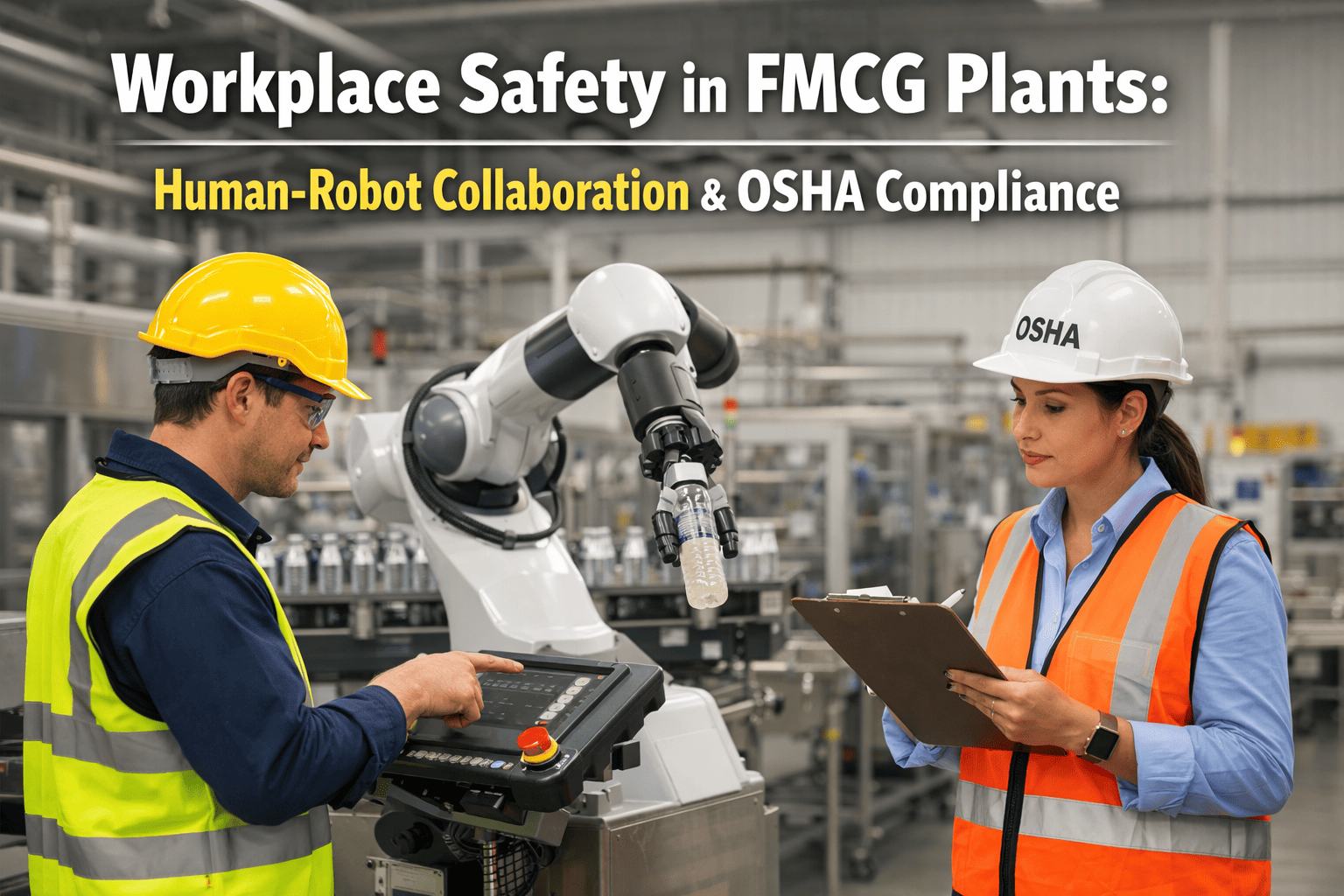
A Pennsylvania confectionery plant was assessed $156,000 in OSHA penalties after a packaging operator's hand entered a cobot safety zone during changeover, per a maintenance-software vendor's analysis citing OSHA enforcement data. The cobot itself was compliant with ISO/TS 15066 force limits. The penalties were for missing paperwork: no documented risk assessment for the changeover scenario, no updated lockout/tagout procedure for the cell, no CMMS record of safety sensor testing in 14 months.
The vendor's analysis claims robot-related citations in food manufacturing rose 38% year-over-year, with 72% targeting documentation gaps rather than injuries — numbers worth verifying against primary OSHA data before quoting in legal contexts, but consistent with the Rivian enforcement pattern we've been tracking. Per OSHA's own robotics page, there are still no specific OSHA standards for the robotics industry, which means enforcement runs through existing machine guarding and lockout/tagout rules — and the documentation bar is rising faster than most plants are updating their files.
What changes if this pattern continues: liability shifts decisively to integrators and end users with weak paperwork hygiene, and insurance underwriters start conditioning coverage on documented risk assessments tied to ISO 10218-1:2025 and ISO/TS 15066. What failure looks like for a plant operator: a routine inspection turns into a five-figure citation because the CMMS record of a sensor test doesn't exist. The signal to watch is whether carriers begin circulating broker bulletins requiring specific safety documentation as a condition of cobot coverage.
⚡ What Most People Missed
- Tesla's $25B capex plan targeting July 2026 for Optimus production — and the market punished the stock: Per investor materials, the spend covers six factories, Optimus assembly lines, Cybercab manufacturing, and an Austin chip fab. Shares initially rose on Q1 earnings, then reversed sharply on the same trading session when the capex figure landed. The market is pricing execution risk before a single commercial Optimus ships — which is itself a useful signal about how investors are now reading physical-AI promises.
- Richtech Robotics turned a Las Vegas building purchase into a physical automation signal: Per the company's April 7 Form 8-K, Richtech bought a roughly 79,325-square-foot Las Vegas building for warehousing, assembly, light manufacturing, R&D, and robotics-driven data collection. Richtech is not Fanuc, but an SEC filing for fixed assets is harder evidence than a press release.
- Accenture invested in General Robotics, and the orchestration layer keeps getting more crowded: General Robotics' GRID platform connects multi-vendor robot fleets with simulation and orchestration. The bet is that mixed-fleet coordination — not the robots themselves — is where recurring revenue settles. The robotics winners may be the companies that never build a robot.
- Virtual PLCs are moving from engineering talk to plant-floor decisions: Software-based programmable logic controllers — control logic decoupled from physical boxes — are showing up in real procurement evaluations. Faster testing, easier disaster recovery, tighter digital-twin integration. Not ready for every plant; very ready for some.
- China's "robots making robots" Guangdong story is widening the production gap: Per Chinese state media, automated lines in Guangdong are being used to build the next generation of industrial robots — a closed-loop iteration model. The IFR's Americas release puts the structural gap in context: the Americas had 393,700 operational industrial robots and 34,200 installations in 2024; China's installed stock is roughly five times larger.
📅 What to Watch
- If BMW or another named Figure customer publishes verified cycle-time data this quarter, it means humanoid ROI has moved from vendor math to customer math — which is the moment procurement budgets get rewritten.
- If a major commercial insurance carrier conditions cobot coverage on documented ISO 10218-1:2025 risk assessments, OSHA's enforcement vacuum stops mattering — underwriters become the de facto regulator on a faster timeline than rulemaking.
- If FANUC's Michigan permits accelerate into 2026 hiring filings, the reshoring signal extends from end users to the supplier tier — and integrators should expect lead-time relief, not tightening.
- If Siemens publishes throughput numbers from the Erlangen humanoid pilot, the conversation shifts from "can humanoids work in factories" to "which factories first" — a procurement question, not a research question.
- If Chinese rare-earth export restrictions extend harmonic-drive and torque-motor lead times into Q3, it shows up in integrator order books before OEM press releases — watch the quiet downstream complaints, not the upstream announcements.
- If a Tier 1 carrier circulates a broker bulletin requiring fleet-orchestration interoperability standards, the orchestration-layer thesis stops being a venture bet and becomes a coverage requirement.
The Closer
A confectionery plant paid $156,000 after regulators found no documented sensor test; a German bearings supplier orders 1,000 humanoids and insists on putting its own actuators inside them; Tesla announces $25 billion in factories and the stock sold off on the session. The most expensive thing in robotics this week wasn't a robot — it was the paperwork nobody filed and the conviction nobody had. Until next Sunday.
If you know someone who'd rather read this than sit through another humanoid demo reel, send it their way.
From the Lyceum
FERC's grid interconnection rule will be litigated before the ink dries — and it directly shapes where you can site an automated facility. Read → The Legaltech Brief
Five governments published a joint security playbook for AI agents, and factory software will inherit those controls next. Read → The Agentic Brief
Lowe's Foundation quintupled its trades training commitment to $250 million — quiet evidence that labor scarcity is still shaping automation economics. Read → The Trades Brief
Canada is putting $6 billion behind closing a 20,000-worker annual gap, which is also an automation story in disguise. Read → The Trades Brief