Robotics & Automation Weekly — Apr 26, 2026
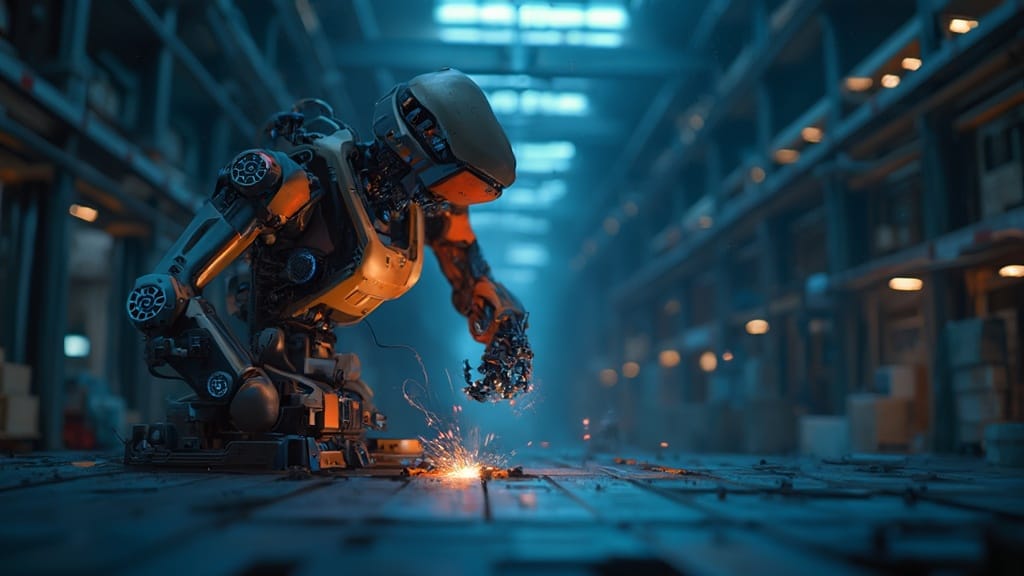
Photo: lyceumnews.com
Week of April 26, 2026
The Big Picture
This was the week the humanoid story stopped being about the robot and started being about everything around it. A humanoid ran an autonomous shift in a Siemens factory with real numbers attached. ABB launched a cobot family that bets it can finally close the speed gap to industrial arms. And the largest U.S. military shipbuilder put physical AI at the center of how it intends to build submarines. The hardware is catching up; integration, labor agreements, and regulatory plumbing appear to be the constraints.
What Just Shipped
- PoWa cobot family (ABB Robotics): Six payload variants from 7–30 kg, top speed 5.8 m/s, IP65/IP67, available globally now.
- HMND 01 Alpha (Humanoid): Wheeled humanoid that completed an 8+ hour autonomous tote-handling shift at Siemens Erlangen with 60 moves/hour and above 90% pick success during the trial.
- HYPR Program (HII, Path Robotics, GrayMatter Robotics): Multi-vendor physical AI shipbuilding line announced at Sea-Air-Space Expo; proof-of-concept 2026, pilot 2027.
- Mujin picking deployment (Mujin): Intelligent picking arms rolled out across Japanese auto-parts warehouses, per the company's announcement.
- Chef Robotics production milestone (Chef Robotics): 100 million cumulative servings portioned in live food production since 2022.
This Week's Stories
A Humanoid Worked a Full Factory Shift in Germany — and the Numbers Are Real
Most humanoid announcements come with a polished video and a vague gesture toward "production readiness." This one came with a throughput number.
According to Siemens' announcement, the HMND 01 Alpha — a wheeled humanoid from UK startup Humanoid, founded in 2024 — was deployed in logistics operations at Siemens' Erlangen electronics factory, where it autonomously picked totes from storage stacks, transported them, and placed them at conveyor pickup points for human workers. Siemens reports the robot met target metrics: roughly 60 tote moves per hour, uptime exceeding eight hours, and autonomous pick-and-place success above 90% during the trial. The trial ran for two weeks in January 2026, with results disclosed at Hannover Messe this week, per The Next Web.
The integration story is the bigger one. The robot was wired into Siemens' Xcelerator platform — digital twin, fleet management, PLC-robot interfaces, real-time coordination with AGVs and human workers. Siemens described Erlangen as "customer zero," which is the tell: Siemens is not just using a humanoid, it's preparing to sell humanoid integration as a packaged capability through Xcelerator.
If that pathway works, the winners are the industrial software incumbents — Siemens, Rockwell, possibly SAP — not the humanoid OEMs, who become commoditized hardware suppliers underneath an orchestration layer. If it fails, watch for whether the 90% success rate degrades when the task envelope expands beyond tote handling. The signal to track: whether Siemens names external customer deployments through Xcelerator in the next two quarters.
ABB Just Launched the Cobot the Middle Market Has Been Waiting For
There's a frustrating gap every systems integrator knows: standard cobots are too slow and too light for real industrial work, but full industrial robots are too rigid for flexible, high-mix production. ABB just launched a product aimed squarely at that gap.
Per ABB's announcement, the PoWa family spans six payload categories from 7 kg to 30 kg with a top speed of 5.8 m/s — well above the 1–2 m/s typical of cobots. ABB says the units run on its OmniCore controller with integrated force sensing and ISO/TS 15066 collaborative behavior, ship with IP65/IP67 protection, support ISO Class 4/5 cleanrooms, and can be unboxed and operational within an hour. The Robot Report adds that ABB is lining up European pilots in Q3.
The dirty secret of cobots is that making them safe around humans usually makes them too slow to hit serious cycle times. PoWa explicitly bets it can change that calculus. If integrators actually deploy these unfenced at top speed, the addressable market for cobots expands into work currently done by caged industrial arms — a structural shift in cell design. If conservative safety risk assessments force velocity to be dialed back in practice, PoWa becomes another premium cobot that gets compared on payload to Universal Robots' UR20 and Fanuc's CRX-25iA.
One contextual note: ABB Group announced the sale of its robotics unit to SoftBank for $5.3 billion in October 2025, per The Robot Report. The deal had not closed as of April 26, 2026. Watch whether the ownership transition affects PoWa's ability to land multi-year supply agreements.
The Navy's Shipbuilding Robot Program Is More Serious Than the Press Release Suggests
Shipbuilding is one of the hardest manufacturing environments to automate — large structures, variable geometry, military-spec welds. Which is why HII's announcement at Sea-Air-Space Expo this week is worth reading carefully.
HII, together with Path Robotics and GrayMatter Robotics, introduced the High-Yield Production Robotics (HYPR) program, per the company's release. HYPR combines robotic welding (Path Robotics' Obsidian model adapts to weld joint variations in real time), automated material movement, autonomous surface treatment and inspection (GrayMatter Robotics), and autonomous quality checks into a coordinated assembly line. Proof-of-concept demonstrations are planned for 2026; a full pilot is targeted for 2027.
The number that makes this credible: HII reports shipbuilding throughput was up 14% year-over-year in 2025, with a target of an additional 15% year-over-year in 2026. That operational improvement helps explain why HII is reaching for tools that didn't exist five years ago.
If HYPR works, defense procurement becomes a serious validation customer for physical AI, which changes the funding landscape for the entire sector. If it stalls, expect it to stall at the orchestration layer — coordinating two vendors' AI systems on a shipyard floor is the unsolved problem. The signal to watch is whether the Boilermakers, who represent the welders this program is designed to augment, get a formal seat at the bargaining table at Newport News and Ingalls.
FANUC's $90 Million Michigan Build Is Reshoring You Can Touch
When the world's largest industrial robot maker pours concrete in North America, it's not a press release — it's a demand forecast.
Per Automation World, FANUC America announced a $90 million Michigan facility expansion this month. Coupled with the company's Q2 reporting, which Fanuc America says shows a material jump in North American orders for heavy-payload welding and fabrication arms tied to Midwest greenfield projects, the picture is consistent: order intake is converting into local capacity commitments.
If FANUC's permitting advances on schedule, expect ABB, Yaskawa, and KUKA to answer with their own North American moves — at which point integrator and component lead times tighten across the board. If the project slows, it suggests the order book is softer than headline numbers imply. Watch the permitting filings and electrical contractor announcements; those are the real timing signals, not the ribbon cutting.
Chef Robotics Hit 100 Million Servings — and That's a Real Deployment Benchmark
Food service automation is one of the least glamorous corners of robotics, which is exactly why it produces some of the most honest deployment data. Nobody writes concept papers about portioning chicken — either the robot does it at production speed or it doesn't.
Chef Robotics announced its robots have crossed 100 million servings in live production since the first customer deployment in 2022, per the company. That's four years of real operation handling variable, deformable ingredients at production-line speeds — the part of food automation that actually resists automation, because most existing systems handle packaging, where the product is already a defined shape.
If Chef publishes per-serving economics, the next wave of food manufacturers will move quickly. If it doesn't, the milestone stays a marketing line. The signal to watch is whether one of the company's customers names cost-per-portion in their own investor materials.
DC Metro's $900M Automation Push Collides with the Transit Union
Per Trains coverage, WMATA's board approved a roughly $900 million capital plan to automate the Red Line by 2032, and the union response was immediate and formal. Treat the dollar figure as reported until it appears in WMATA's own filings.
The technical case for transit automation is well-established. The political and labor case is not. If WMATA secures Federal Transit Administration funding despite union opposition, it sets a precedent that other large metros — Chicago, Boston, the Bay Area — will use to accelerate their own automation timelines. If FTA funding stalls or gets conditioned on labor agreements, the precedent runs the other direction. Either way, this is the cleanest test case in years for whether public automation capex can survive contact with organized labor.
The OSHA Vacuum Is Getting Structurally Larger as Humanoid Pilots Multiply
Per OSHA's own materials, there are still no specific OSHA standards for the robotics industry. Citations for robot-related incidents continue to lean on Lockout/Tagout (1910.147), Machine Safeguarding (1910.212), and the General Duty Clause — the last of which the Eleventh Circuit weakened in early April, as we covered two weeks ago.
Two things changed the texture this week. First, the revised ANSI/A3 R15.06-2025 package — which harmonizes with ISO 10218-1 and -2 — has expanded integration, safeguarding, and documentation expectations, per The ANSI Blog. Procurement teams and insurers are increasingly treating it as the de facto checklist. Second, OSHA reportedly cited an Amazon fulfillment center for an AMR collision incident — the third such citation in 2026, per OSHA's release. (Treat the "third in 2026" framing as the agency's characterization until docket details are public.)
If the EU Machinery Directive revision passes with mandatory AI safety logs and remote diagnostics for robot fleets — currently in consultation, per the European Commission — exporters face a retrofit cost shock and U.S. integrators inherit a de facto global standard. If it gets watered down, the gap between deployment velocity and regulatory clarity widens further. The signal: whether large insurers begin formally repricing AMR/human-mix risk this quarter.
⚡ What Most People Missed
Tesla disclosed $25 billion in 2026 capex while the rare-earth magnet constraint on Optimus actuators remains publicly unresolved. Per Intellectia's read of Tesla's Q1 earnings call, the company framed the rollout as part of a "very big capital investment phase."
Rockwell Automation's Q1 commentary points to order growth tied to U.S. capacity projects — controls, drives, and integration spend showing up before visible plant builds, per Rockwell's prepared remarks. The mid-market is queuing up safety PLCs and integration contracts before the ribbon cuttings.
Accenture, SAP, and Vodafone Procure & Connect ran a humanoid pilot in a Duisburg warehouse, per Robotics 24/7. The robot inspected pallet stacking and reported findings into SAP. When Big Four consultants and the largest ERP vendor start treating humanoids as a billable service line, the adoption curve compresses faster than hardware OEMs have priced in.
Teamsters at United Natural Foods in Pompano Beach ratified a first contract with a reported 31% wage increase over five years, per the Teamsters' announcement. Stronger warehouse contracts shift the automation ROI calculus and may start naming automation clauses directly rather than handling them through generic seniority language.
📅 What to Watch
- If Siemens names external Xcelerator humanoid customers in the next two quarters, the orchestration layer — not the robot — becomes the durable margin pool, and humanoid OEMs slide toward commodity supplier status.
- If China resolves Tesla's rare-earth magnet export license, expect a wave of competitor humanoid programs to pull forward 2027 timelines; if it doesn't, Optimus's July production date risks slipping regardless of Tesla's $25B capex.
- If insurers formally reprice AMR/human-mix risk this quarter, underwriting becomes the binding compliance regime for warehouse automation before OSHA writes a single new rule.
- If FANUC permitting advances on schedule in Michigan, expect ABB, Yaskawa, and KUKA to announce North American capacity within two quarters — and lead times across integrators will tighten before customers notice.
- If FTA funds WMATA's Red Line automation despite union opposition, every other large metro's automation timeline pulls forward by years.
- If HII names a defense procurement contract attached to HYPR before year-end, physical AI gets its first durable defense customer — and the validation flywheel for the whole sector starts spinning.
The Closer
A humanoid stacking totes in Erlangen while Accenture pitches it as a billable line item, a $25 billion capex slide that quietly depends on a Chinese export license nobody will discuss on the earnings call, and a transit board approving a $900 million automation plan with a union lawyer already in the lobby. The robots are ready; the bargaining tables, the bond markets, and the magnet supply chains are the constraint — which is somehow exactly what the people who actually build factories have been saying for thirty years. Until next week.
Forward this to the integrator in your life who keeps muttering about safety PLC lead times — they'll feel seen.
From the Lyceum
FERC has set a June deadline to rewrite the rules for AI power demand — and every automated facility with a serious compute footprint is in scope. Read → Legaltech