Macro & Markets Daily — Apr 20, 2026

Photo: lyceumnews.com
Monday, April 20, 2026
The Big Picture
Friday's peace rally lasted exactly 48 hours. The USS Spruance intercepted and seized an Iranian cargo ship over the weekend, Iran again shuttered the Strait of Hormuz, and Monday's session opened with oil ripping higher — giving back most of Friday's historic crash in a single day. Brent closed at $94.90, up 5.00% on the session; WTI closed at $86.78 on the session. The damage on Wall Street was surprisingly mild: the S&P 500 closed down 0.24% on the session at 7,109.14, the Nasdaq closed down 0.26% on the session at 24,404.39 — snapping a 13-session win streak — and the Dow closed down 0.01% on the session at 49,442.56, basically flat. The 10-year Treasury yield ticked up to 4.25% on the session, the VIX jumped 8% on the session to 18.87, and the Russell 2000 closed at a fresh record of 2,792.96. That combination is consistent with a market pricing of stagflation risk, not a pure growth scare. The two-week U.S.-Iran ceasefire expires Wednesday, and right now it's the only thing on the calendar that matters.
Today's Stories
The Strait Slammed Shut — and Oil Took Back Half of Friday's Crash
Friday felt like a turning point. Iran announced the Strait of Hormuz was open, oil cratered more than 9% on Friday, stocks hit all-time highs, and traders priced in a peace deal. Then the weekend happened.
According to U.S. Central Command, the guided-missile destroyer USS Spruance intercepted the Iranian-flagged M/V Touska in the north Arabian Sea and — after a six-hour non-compliance standoff — fired several rounds from its 5-inch gun into the engine room, disabling the vessel. Iran responded by firing on commercial shipping and shuttering the Strait again. On Saturday, more than 20 vessels transited Hormuz, the highest count since March 1. By Sunday, zero vessels transited. The pre-war daily average was 138.
Brent closed at $94.90, up 5.00% on the session. That's oil giving back nearly all of Friday's peace-deal drop in a single session.
If this escalates: the ceasefire expires Wednesday, Iran has said it will not attend a second round of talks in Islamabad, and insurers could pull coverage on Gulf tankers — a move that, per analysts cited by Investing.com, would mechanically add $10 to crude. If it de-escalates: expect a repeat of Friday's unwind, with airlines and small caps leading a relief bid. The signal to watch is the transit count through Hormuz — it's a daily readout, and right now it is at zero.
Stocks Barely Flinched — and That's the Real Story
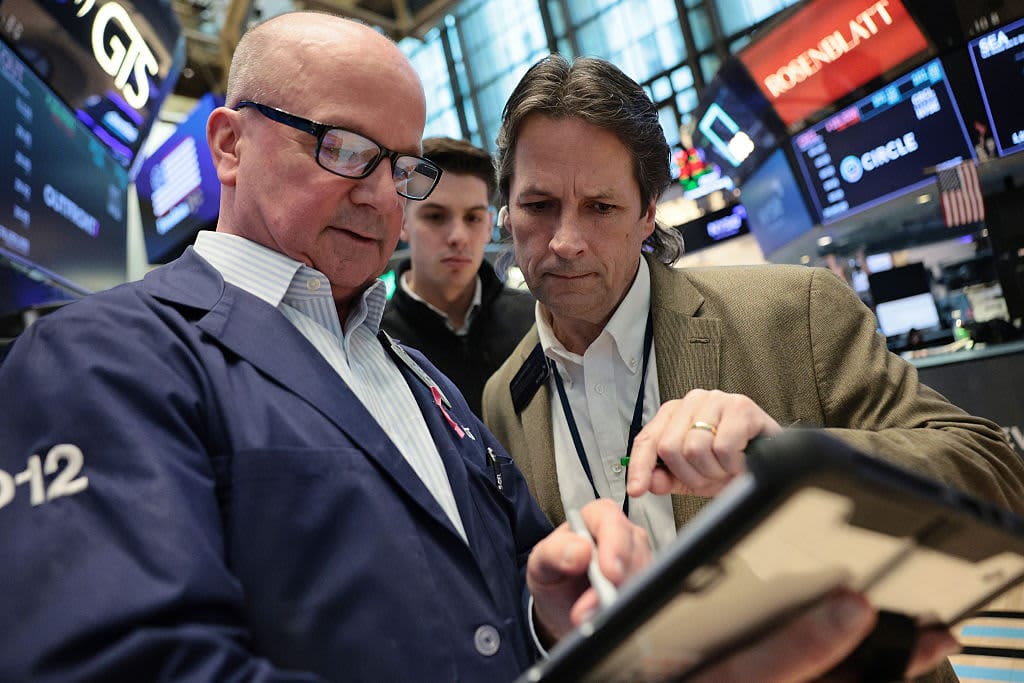
Here's what's strange about today: oil surged 5.00% on the session, the Strait is closed, peace talks are in tatters — and the S&P 500 fell less than a quarter of a percent on the session. That's not complacency. It's a thesis.
The Nasdaq snapped a 13-day winning streak (its longest since 1992) with a 0.26% loss on the session. The Dow lost four points on the session. But the Russell 2000 — smaller U.S. companies less exposed to global energy costs — rose 0.58% on the session to close at a record 2,792.96. Chip stocks, tracked by the iShares Semiconductor ETF, extended their own streak to 14 sessions, the second-longest ever, behind only a June 2014 run.
The rotation suggests investors are reallocating toward companies insulated from oil rather than fleeing risk. The market currently treats an eventual U.S.-Iran compromise as the base case; the risk is being right about the outcome but wrong about the timeline. Wednesday's ceasefire expiry is the first real test of that bet. Watch the VIX — it is 18.87 after an 8% jump on the session; a close above 22 would indicate the thesis is cracking.
Gold Fell on an Oil Spike — Here's Why That's Weird
In a normal world, when naval combat erupts in the world's most important oil chokepoint, gold goes up. Today it closed at $4,835.90, down 0.45% on the session.
One possible mechanism is this: higher oil feeds inflation, which reduces the chance of near-term Fed rate cuts, which can push real interest rates (nominal yields minus inflation) higher — and higher real rates are typically negative for gold. Morgan Stanley's commodities desk put it directly in a Monday note: "With the conflict triggering an energy supply shock that has reduced hopes for lower Fed rates, it is not surprising that gold has struggled to work as a safe haven this time." They trimmed their H2 2026 target to $5,200 from a prior bull case of $5,700.
What changes if this holds: the safe-haven playbook gets rewritten. In a world where geopolitical shocks are inflationary rather than deflationary, gold could lose its reflex bid and energy equities could become the hedge instead. The signal that would flip it is a genuine growth scare — weak retail sales Tuesday or a soft jobless claims print Thursday — that pulls yields down even as oil stays elevated. That's the scenario where gold would likely recover. Until then, the Fed–inflation–gold triangle is the cleanest macro tell on the tape.
⚡ What Most People Missed
Oil is a fertilizer story, not just an energy story. The LNG disruption through Hormuz hits nitrogen fertilizer production right as the Northern Hemisphere spring planting season begins. Unlike oil, fertilizer has no coordinated strategic reserves. Lower corn yields would feed into U.S. beef, poultry, and dairy inflation — a 2027 CPI problem hiding inside a 2026 headline.
India was pulled into the incident: New Delhi summoned Iran's ambassador after Iranian gunboats fired on two Indian-flagged merchant ships during Saturday's brief Hormuz reopening, per The National. India is the world's third-largest oil importer, has been quietly buying discounted Iranian crude, and has been trying to stay neutral. A forced realignment would reshape Asian energy flows and EM currency dynamics the market has not yet fully discounted.
Mortgages are already moving. Mortgage News Daily's lender-based index shows the 30-year fixed rate at about 6.53% on April 20, 2026, up roughly 10 basis points from its prior daily reading. That's the real-economy transmission of today's oil spike — arriving before any government data can catch up to it.
Tuesday's U.S. retail sales print is the week's most important number. March was peak oil-shock month, with crude above $100 and consumer sentiment at record lows. A miss would be the first hard evidence the consumer is buckling; a beat keeps the "resilient consumer" narrative alive for another cycle.
Russia's fiscal picture is quietly feeding into commodity markets. Reports that Moscow is acknowledging deeper economic stress than official figures suggest — combined with Sergey Lavrov's Monday call to Iran's Saeed Jalili urging the ceasefire hold (per the Times of Israel liveblog and Asharq al-Awsat) — hint at a Russia increasingly reliant on preferential Hormuz passage and Iranian cooperation. If that diplomacy buys time before Wednesday, it's a floor on risk. [Source: Wall Street News — Chinese (Simplified)]
📅 What to Watch
- If Tuesday's U.S. retail sales print comes in negative, Q2 GDP nowcasts get slashed and the Fed's stagflation bind worsens, amid energy-driven inflation plus a cracking consumer that would leave the Fed with few good policy options.
- If United Airlines' Tuesday fuel guidance assumes Brent above $90 for H2, the entire airline sector re-rates lower overnight and it signals management is forecasting sustained higher fuel costs in H2 rather than expecting a near-term ceasefire to normalize prices.
- If Tesla's Tuesday report emphasizes AI narrative over delivery numbers (consensus: $21.46B revenue, 358,023 Q1 deliveries per Tesla IR), it signals management may be pivoting to storytelling to mask demand softness, accelerating the Mag 7 rotation.
- If the ICE BofA High Yield spread widens while the Russell 2000 holds its record, that divergence would be the first crack in the small-cap leadership story — roughly 41–46% of Russell 2000 companies cannot cover interest expense with operating profits, per the Investing.com analyst framework.
- If Wednesday passes without a ceasefire extension announcement, oil would likely test $100 and the Fed's April 28–29 meeting would present higher odds of a hawkish outcome than futures currently imply.
- If Kevin Warsh signals even modest dovishness in public remarks, the long end of the curve would likely rally hard — he has been perceived as one of the more hawkish voices in markets, and any softening would revise the 2026 rate path.
The Closer
A destroyer firing 5-inch rounds into an engine room, a 13-day tech streak dying with a whimper, and gold — gold — falling on a naval battle in the Persian Gulf. The market has decided that geopolitical shocks are now an inflation trade, which is either sophisticated or delusional, and Wednesday will tell us which. Back tomorrow.
Forward this to the friend who still thinks gold goes up when things blow up.