Macro & Markets Daily — Apr 07, 2026

Photo: lyceumnews.com
Tuesday, April 7, 2026
The Big Picture
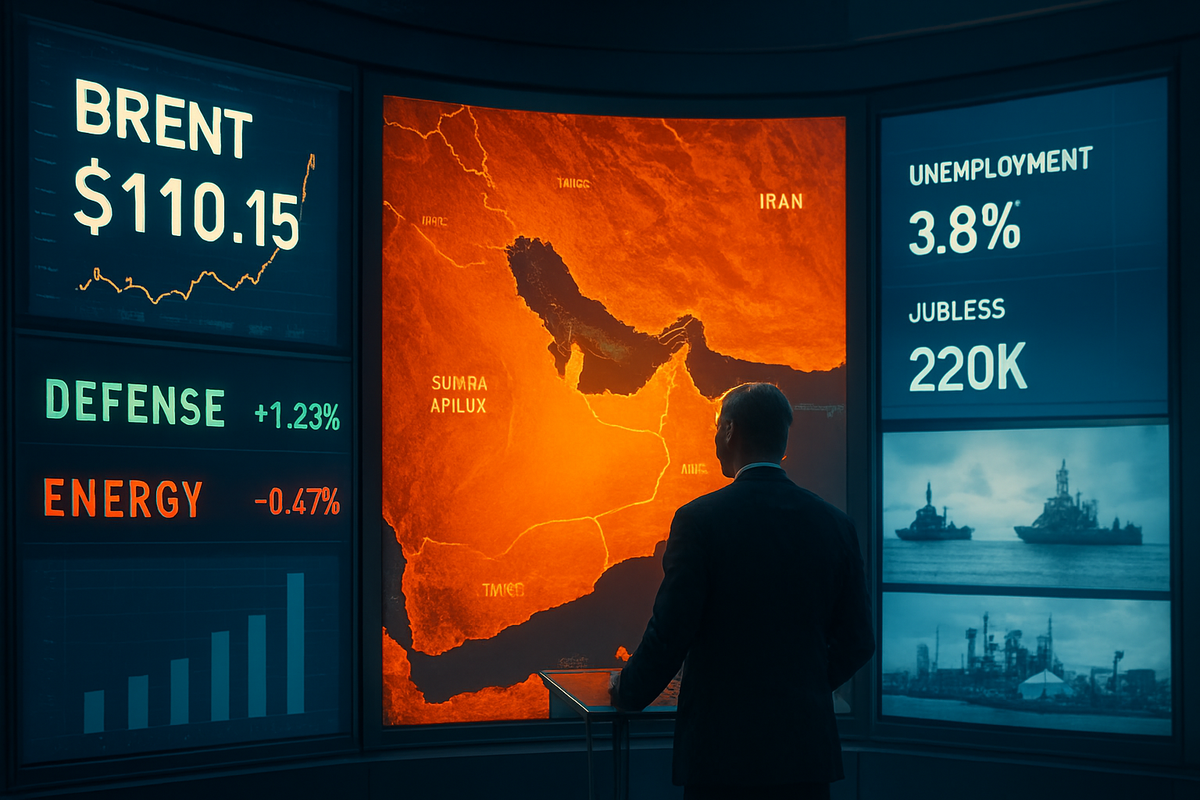
The U.S. struck military targets on Kharg Island again, Iran attacked Saudi Arabia's Jubail petrochemical complex, Tehran severed its last diplomatic channels with Washington, and Russia and China vetoed the UN resolution to reopen the Strait of Hormuz — all before Trump's 8 p.m. ET deadline, which as of this writing has not yet passed and remains the single most important variable in global markets tonight. The S&P 500 closed at 6,573, down 0.58% on the session; the Nasdaq closed at 21,812, down 0.84% on the session; and the Dow closed at 46,535, down 0.29% on the session. Brent crude spiked above $116 at session highs intraday before settling above $110. The 10-year Treasury finished near 4.33% at the close, barely moving despite the chaos — a stalemate between safe-haven demand and rising inflation expectations that will snap one direction or the other depending on what happens in the Gulf tonight.
Today's Stories
The 8 p.m. Deadline: What the Market Was Actually Pricing
The most important number in markets today wasn't on any terminal — it was a clock. Trump's self-imposed 8 p.m. ET deadline for Iran to reopen the Strait of Hormuz expires tonight, and the threat behind it is explicit: Trump threatened to bomb all of Iran's power plants and bridges, according to KHOU. The Kharg Island strikes — reportedly targeting more than fifty military sites roughly 12 hours before the deadline — were the opening bid.
Iran's answer: no deal. Tehran rejected a temporary ceasefire, arguing it would give the U.S. and Israel time to regroup, and instead put forward a 10-point proposal demanding sanctions relief, a compromise on uranium enrichment, and a new order in the Strait. Iran also severed all remaining diplomatic channels with Washington. Russia and China vetoed the UN Security Council resolution to reopen Hormuz, eliminating any multilateral off-ramp.
The S&P 500 was down more than 1% at session lows but clawed back after 1:30 p.m. ET headlines that the UN Secretary-General's envoy was en route to Tehran. The VIX closed around 27 on the session — elevated but not panicked, partly because it was the lowest-volume day of the year. Low volume plus a moderate VIX on a day like this is a warning sign, not comfort. When real news breaks tonight, the market that reacts will be a thin one.
If the deadline passes and the U.S. escalates strikes to energy infrastructure targets, Brent could gap significantly higher at the Asian open and the entire supply-shock calculus changes. If a surprise deal emerges, expect a sharp risk-on rally. The observable signal is simple: watch the first 30 minutes of Asian futures trading.
Kharg Island and Jubail: The War Just Went Gulf-Wide
Two strikes today redrew the conflict's map. The U.S. struck military targets on Kharg Island — Iran's primary oil export hub, roughly 8 square miles, handling about 90% of Iran's crude shipments — and, according to CNN, left the island's oil-export infrastructure standing. Meanwhile, Iran's Islamic Revolutionary Guard Corps launched medium-range missiles and suicide drones at Saudi Arabia's Jubail petrochemical complex — the heart of the kingdom's downstream sector, a 1,016-square-kilometer industrial zone producing roughly 60 million tonnes of petrochemicals annually — according to Al-Monitor and Hydrocarbon Processing. Saudi air defenses intercepted seven ballistic missiles, but debris fell near energy facilities and a fire broke out at the site, damaging some onsite infrastructure.
Here's the part that isn't getting enough attention: a successful intercept doesn't mean the target is safe. Jubail accounts for an estimated 6–8% of global petrochemical output, per House of Saud, and that volume has no substitute supplier. Buyers with SABIC and Sadara contracts are already navigating force majeure declarations. The $9 billion PAC-3 missile sale Washington approved in February hasn't been delivered, leaving Riyadh defending its industrial heartland with a shrinking interceptor stockpile.
The oil market's reaction tells the story: Brent spiked to nearly $116 at session highs intraday despite oil-export infrastructure not being confirmed directly hit. Physical "dated Brent" cargoes are trading at a record premium to futures — some market reports put dated Brent near $144/barrel — a gap that acts like a hidden tax on refiners and airlines before it ever shows up in CPI. If Kharg's oil terminals get hit next, that's a different category of supply shock entirely. If physical prices keep diverging from futures, the margin squeeze will show up in corporate guidance within weeks.
Williams Says the Fed Is "Well-Positioned" — While the CPI Grenade Approaches
New York Fed President John Williams used a Tuesday symposium to declare that policy is "well-positioned" and that he expects underlying inflation to stay near its recent 2.7% range, even with the Hormuz oil shock. He endorsed a higher-for-longer path — no cuts unless demand breaks, no hikes unless inflation re-accelerates. The CME FedWatch Tool shows the market agrees: roughly 79% odds that rates stay paused all year, with cut and hike probabilities each sitting near 10%, as of this session, per Schwab.
The problem is Friday. MUFG's FX desk flags that headline month-over-month CPI for March is expected to jump to 1.0% month-over-month — the biggest monthly gain since June 2022. The ISM Services Prices Paid index already surged from 63.0 to 70.7 in March, the highest since October 2022. The EIA forecasts retail gasoline peaking near $4.30/gallon in April and diesel above $5.80.
If Friday's CPI prints at or above 1.0% month-over-month while Jubail is still smoldering, the "well-positioned" narrative collapses and markets will price a materially more hawkish Fed path. The observable signal: watch the 2-year Treasury yield after the print. A sharp move above 4.40% would indicate the market is pricing out any remaining rate-cut odds for 2026. Wednesday's FOMC minutes from the March meeting will offer the first detailed read on how seriously the committee was already treating stagflation risk — and whether Williams' calm is shared or contested.
⚡ What Most People Missed
- The Russia-China UN veto is the structural story nobody's trading. By blocking the Hormuz resolution, Moscow and Beijing guaranteed that any deal must be bilateral between Washington and Tehran — no international framework to enforce it. That makes a durable agreement structurally harder, not just politically harder, and increases the duration premium priced into energy contracts.
- The Brent futures curve is priced for a short, sharp shock — not a prolonged disruption. According to MUFG, the front-to-third-month spread still implies a retracement, unlike the early Ukraine invasion when the curve priced sustained elevation. Polymarket puts 81% odds on WTI hitting $120 in April 2026, per Benzinga. If escalation hits energy assets, that curve optimism unwinds fast.
- Mortgage rate sheets repriced worse today. A desk note on Reddit flagged agency MBS down 5/32–7/32, translating to roughly 0.125 discount point worse for retail borrowers. Rate-sensitive corners reprice before credit spreads widen — this is an early-cycle stress tell for housing demand.
- Apple fell about 4% on the session on reports of foldable iPhone testing setbacks, per Trading Economics citing Nikkei. A meaningful single-day move for the world's largest company that had nothing to do with Iran — a reminder that company-specific execution risk is alive underneath the geopolitical noise.
- High-yield credit spreads quietly tightened below 3% on the session for the first time since early March, per Schwab. The credit market and the equity market are telling different stories — that divergence is a second-order signal for relative-value and cross-asset positioning.
📅 What to Watch
- If Trump's 8 p.m. deadline passes without a deal and strikes escalate to oil infrastructure targets, Brent could gap $10+ higher at the Asian open — watch the first 30 minutes of Nikkei and Shanghai futures for the market's real-time verdict.
- If Wednesday's FOMC minutes reveal genuine division on stagflation, the 2-year yield could break above 4.40% and kill the remaining rate-cut narrative — that reprices every duration-sensitive portfolio in the market.
- If Delta pulls full-year guidance on its Wednesday pre-market call (consensus EPS $0.61), expect a read-across selloff in airlines, logistics, and consumer discretionary — the first corporate data point on what $110+ oil costs American companies.
- If Friday's CPI prints at or above 1.0% month-over-month, the "transitory energy shock" thesis dies and the Fed's frozen posture becomes untenable — watch for hawkish repricing in fed funds futures within minutes.
- If the dated-Brent-to-futures spread stays above $30, it signals sustained physical scarcity, not just speculative positioning — refiners' margins compress before the next earnings cycle even starts.
The Closer
Kharg Island's oil terminals are still standing like a hostage nobody's ransomed yet, a Saudi interceptor stockpile is shrinking with every successful shoot-down, and John Williams spoke from a symposium podium insisting everything is "well-positioned" while the ISM Prices Paid index screams behind him like a car alarm no one acknowledges.
The futures curve says this resolves quickly; the IRGC just proved it can set Saudi Arabia's industrial heartland on fire with debris from missiles that were successfully intercepted — pick your optimist.
Eyes open tonight.
If someone you know is staring at a portfolio wondering what just happened, send them this.