Macro & Markets Daily — Apr 01, 2026

Photo: lyceumnews.com
Wednesday, April 1, 2026
The Big Picture
Wall Street closed the worst quarter since 2022 with its best single day since last spring — the S&P 500 closed up 2.9% on the session at 6,528.52, the Nasdaq closed up 3.8% on the session at 21,590.63, and the Dow closed up 1,125 points (up 2.5% on the session) at 46,341.51, all amid a China-Pakistan peace initiative that landed in Tehran with the Strait of Hormuz's reopening on the table. But one good day doesn't fix a bad month: the S&P still finished March down roughly 5.3% on the month and the quarter down 4.6% for the quarter. The 10-year Treasury yield closed around 4.31% on the session, Brent crude settled near $108 on the more active June contract on the session (the expiring May contract printed near $119 intraday), and EUR/USD closed up nearly 1% on the session at 1.16. The single question heading into April: is the peace signal real, or is this the latest false dawn in a month that's had several?
Today's Stories
China and Pakistan Drop a Peace Plan — and Markets Buy Every Word
What happened. China and Pakistan jointly presented a five-point initiative to end the Iran war, including an immediate ceasefire and the reopening of the Strait of Hormuz. The plan came together during Pakistan's foreign minister's visit to Beijing on Tuesday. President Trump declined to comment on specifics but told Axios the diplomacy was going well; Axios reported China had been helpful in efforts to reach a deal.
Why China matters. Beijing is Iran's top trade partner and the world's largest importer of Iranian oil. That dynamic could tilt Tehran's incentives toward balancing its most important economic relationship against its leverage over the strait.
The catch that markets may be underpricing. Iran's Foreign Minister Abbas Araghchi pushed back immediately, stating Tehran wants a full end to the war — including guarantees against future attacks and compensation for damages — not a mere ceasefire. That's a vastly higher bar. Meanwhile, Iran's parliament reportedly approved a plan to collect tolls on vessels transiting the strait, according to Middle East Eye — an attempt to convert a temporary military chokepoint into a permanent revenue stream. If that sticks, "reopening" becomes a negotiation about money and sovereignty, not just military access.
What to watch. Any formal Iranian response to the five-point framework. If Tehran counter-proposes rather than rejects, oil could fall $5–8 in the days after a counter-proposal. If it rejects outright, today's rally could unwind within hours. Trump's self-imposed April 6 deadline to strike Iranian energy infrastructure is the backstop clock — the China-Pakistan track is now the only visible diplomatic lane before that date.
The Best Day Since May Was Built on Positioning, Not Conviction
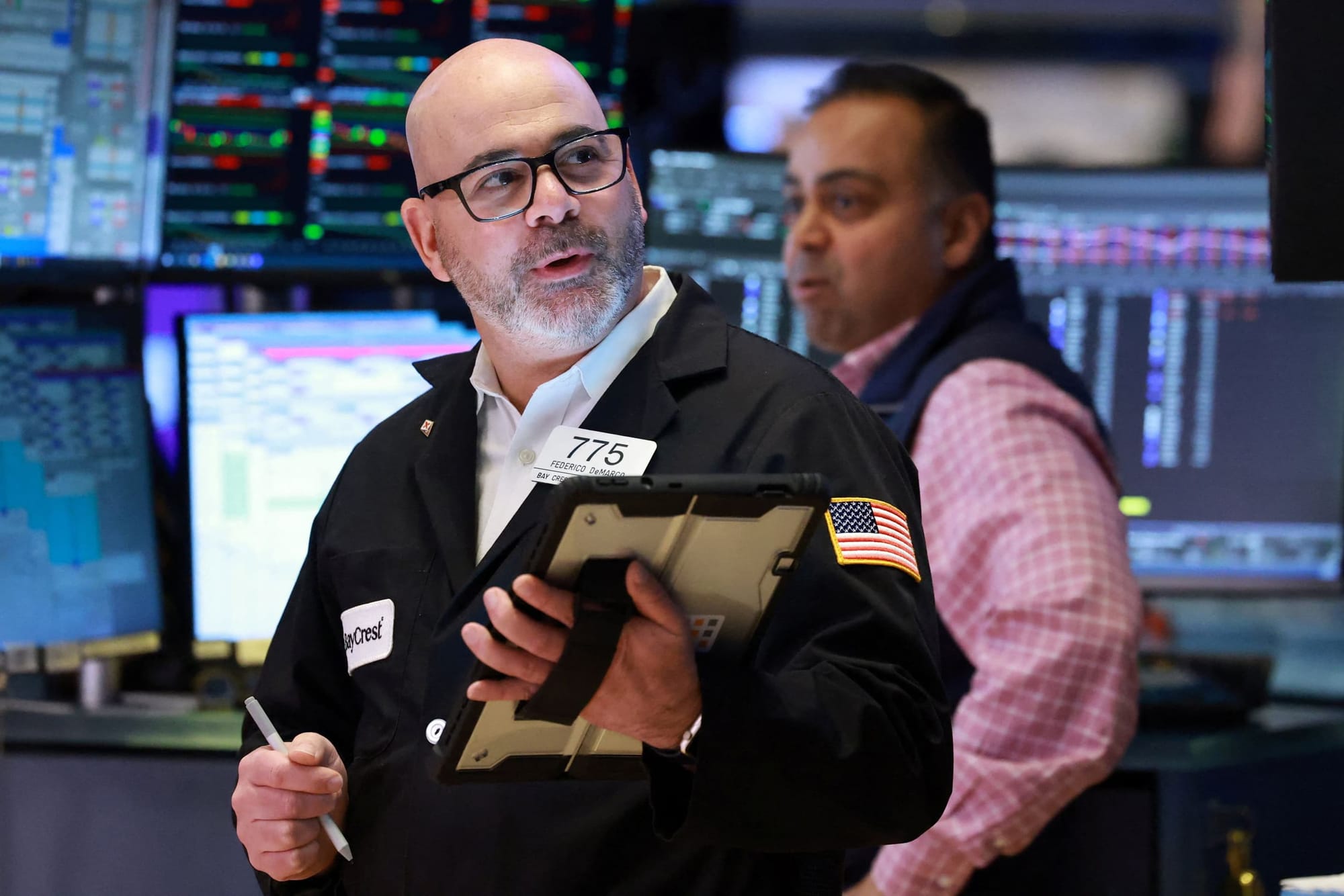
What happened. The Dow closed up 1,125 points (up 2.5% on the session). The Nasdaq closed up 3.8% on the session. The VIX — Wall Street's fear gauge, which measures the price of insuring against big market swings — collapsed 17.5% on the session to 25.25. Today's leaders were Caterpillar (+6% on the session), Nvidia (+5.6% on the session), and Boeing (+5.2% on the session): industrial recovery bets and AI plays, not energy names. Ten of eleven S&P 500 sectors were still negative for March even after the rally, according to CNBC.
The mechanism matters more than the number. This was a quarter-end positioning reset: funds that had been short or underweight for four straight losing weeks covered into March 31, amplifying the move. Systematic strategies — trend-following and volatility-targeting funds that mechanically add risk when realized volatility drops — piled in. According to the Washington Post, the rally leaned heavily on tech names like Microsoft, Nvidia, and Meta, while energy had been the quarter's dominant winner (S&P Energy up roughly 39% year-to-date versus tech down roughly 13%). That's a rotation trade, not a recovery.
What failure looks like. If this was mechanical re-risking rather than durable risk appetite, it fades once quarter-end flows clear. The tell: watch whether small caps and semiconductors hold their gains through Wednesday and Thursday, or whether volume dries up and the rally narrows back to defensive names. A VIX that drifts back above 28 by Friday would confirm the move was borrowed, not earned.
Oracle Cuts 20,000–30,000 Jobs to Fund AI Data Centers — and the Stock Rallies

What happened. Oracle began notifying employees Tuesday of layoffs estimated at 20,000 to 30,000 — roughly 18% of its workforce — delivered via 6 a.m. "today is your last day" emails, according to The Next Web and Washington Times. The cuts are tied to debt-funded data-center buildouts for AI and cloud. The stock rallied more than 4% on the session on the news.
What this changes. This is the clearest real-world example of the "people-for-infrastructure" trade: a legacy enterprise software company swapping headcount for GPU capacity and hoping revenue follows. TD Cowen estimates, per reports, that the cuts could free roughly $8–10 billion to fund the buildout, though Oracle hasn't confirmed those figures. If boards at other enterprise tech firms read this as validation — cut humans, fund silicon — expect a wave of similar announcements in Q2. The stock's rally on a massive layoff suggests the market is pricing this as margin expansion, not distress.
What failure looks like. Oracle has a $2.1 billion restructuring charge already disclosed. If the AI revenue ramp doesn't materialize fast enough to justify the debt load, this becomes a balance-sheet problem rather than a margin story. Watch for an 8-K filing with final headcount numbers and any revision to capital expenditure guidance — that's the document that separates strategic pivot from financial stress.
⚡ What Most People Missed
- The JOLTS report quietly rolled hiring back to pandemic-era levels. February job openings fell to 6.9 million (from 7.2 million), hires dropped to 4.85 million — the lowest since April 2020 — and quits hit their weakest since August 2020, per the AP. The Great Resignation appears to be over; bargaining power is swinging back to employers. For the Fed, softer labor data would support rate cuts while oil-driven inflation would argue against them — a difficult policy tradeoff.
- The physical oil market and the paper market are diverging dangerously. Discussion at S&P Global's CERAWeek conference, per CNBC, centered on the gap between futures prices and what refineries are actually paying for physical delivery — particularly in Asia. The Brent price on your screen is not what a refinery in South Korea is paying, and that spread is a stress signal that daily market wraps almost never cover.
- Iran's IRGC named 18 U.S. tech companies as "legitimate targets," effective April 1. Apple, Microsoft, Google, Meta, Nvidia, HP, Intel, and Oracle are among the firms named, according to The Hill. This shifts the threat from shipping lanes to cloud providers and data centers — a different kind of fragility for AI capex and enterprise software that makes Gulf-region tech infrastructure an active insurance and contingency-planning problem starting on April 1.
- Overnight repo rates spiked 15 basis points to about 4.85% on the session amid quarter-end window-dressing that drained liquidity, per TheStreet. The SOFR-OIS spread widened to its largest level in a month. If funding stress persists into the first week of April, it can quietly tighten credit conditions for leveraged borrowers — even without a headline credit event.
- Bitcoin bled while equities ripped. Even on an equity rally day when the S&P was up 2.9% on the session, Bitcoin ended March under pressure with derivatives data showing rising short interest, per Coindoo. The correlation break suggests some investors are rotating out of the most speculative corners while still buying Nvidia on dips.
📅 What to Watch
- If ISM Manufacturing (Wednesday, 10am ET) prints below 50, it would be the first contraction reading since the oil shock began — and would shift the recession debate from "soft data say maybe" to "hard data say probably," putting immediate pressure on the Fed to signal cuts despite elevated inflation.
- If Iran takes any confirmed action against the tech firms named by the IRGC overnight, Nasdaq futures would reprice immediately and the ceasefire narrative would collapse — watch for Gulf-region cloud and data-center disruption reports as the IRGC's stated April 1 deadline arrives.
- If Friday's nonfarm payrolls (consensus ~130K) come in below 100K, February's JOLTS-style cracks in the labor market would widen into a full narrative shift — bond yields would likely drop sharply and recession probability models could rise above 40% in the weeks after.
- If repo funding stress persists past Wednesday, it signals quarter-end wasn't the only driver — and short-term credit conditions could tighten enough to pressure high-yield spreads and leveraged loan markets without any headline event.
- If Tehran formally rejects the China-Pakistan framework before April 6, Trump's self-imposed deadline to strike Iranian energy infrastructure becomes the market's next binary event — and Brent could retest $116 or higher in the days after.
The Closer
A Kuwaiti supertanker burning in Dubai harbor, Oracle employees learning their careers ended at 6 a.m. via email, and China — of all brokers — trying to reopen the world's most important shipping lane before an American president blows it up on purpose.
Iran's parliament invented a toll booth for international waters, which is the kind of move that would get you laughed out of a Model UN but apparently works fine when you have anti-ship missiles.
Stay sharp out there.
If someone you know is navigating this market without a daily briefing, do them a favor and forward this.