Industry Weekly — Apr 24, 2026
Photo: lyceumnews.com
Week of April 24, 2026
The Big Picture
Shareholders approved the biggest media merger in a generation on Thursday, and by dinnertime the CEO who'll run the combined company was at a Washington event honoring President Trump while a California attorney general sharpened a legal challenge back home. That's the week in one sentence: the Paramount–Warner Bros. Discovery deal is "done" in the way a wedding is done before the in-laws arrive. Meanwhile, SAG-AFTRA walks back into the room Monday with an unresolved AI fight, Disney is milking $1 billion blue aliens before letting them near a subscription, and the studios are all quietly learning the same lesson: harvest the cash now, worry about prestige later.
This Week's Stories
The Vote Is In — Now the Real Fight Begins
Warner Bros. Discovery shareholders voted Thursday to approve Paramount Skydance's $110 billion acquisition of the company, per Variety. The meeting itself lasted about ten minutes — a sort of corporate shrug for a deal that hands Paramount control of HBO, HBO Max, the Warner Bros. film and TV studios, DC, CNN, TBS, TNT, HGTV, and Discovery+, on top of CBS, Paramount Pictures, Paramount+, BET, MTV, and Nickelodeon.
What changes if this closes: one company will control a staggering share of American scripted storytelling, news, and sports rights, and Paramount has told investors to expect $6 billion in "cost savings" — which in corporate dialect means mass layoffs in overlapping writers' rooms, development slates, marketing teams, and below-the-line crews. What failure looks like: a second-request from the DOJ, an EU or UK antitrust intervention, or a formal challenge from California AG Rob Bonta, who per Deadline is widely speculated to be preparing one. The combined company would inherit roughly $80 billion in debt when WBD's existing load is folded in, with Fitch and S&P already rating Paramount's debt at junk status and Moody's reviewing for downgrade, per Deadline. Watch for any DOJ "second request" in the next 60 days — that's the signal the Q3 close is slipping.
Ellison Flew to Washington the Night of the Vote — and That's Not a Coincidence
By Thursday evening, Paramount CEO David Ellison was in Washington for a dinner "honoring the Trump White House and CBS White House correspondents," per CNN, coinciding with the White House Correspondents' Association's annual gathering. FCC chair Brendan Carr said last month that the deal "should get through pretty quickly." Paramount's warm relationship with the Trump administration has, per CNN, "contributed to a widespread perception that the administration has blessed the deal."
Here's the wrinkle Ellison's dinner can't solve: state attorneys general don't RSVP to those events. Per CNN, several Democratic state AGs are examining the deal precisely because they expect federal regulators to wave it through for political reasons — which is the kind of sentence that turns a regulatory victory lap into a two-year state-court slog. If Bonta files, this becomes the most significant state-level antitrust action against a media company in years. If he doesn't, Ellison's strategy works exactly as drawn up.
Hollywood's A-List Revolt Crosses 4,000 Names
Per Variety, the open letter opposing the Paramount–WBD deal now carries 4,194 signatories — up from 1,000 at its April 13 launch — including Robert De Niro, Sofia Coppola, Holly Hunter, Florence Pugh, Pedro Pascal, Edward Norton, Joaquin Phoenix, Jane Fonda, Mark Ruffalo, Glenn Close, and Denis Villeneuve. Organizers say the list includes more than 75 Oscar winners and nominees. Ruffalo testified at a Senate hearing this week framing the merger as a threat to democratic media structures, per Variety Australia.
Open letters usually accomplish nothing. This one has a specific job: provide political cover for state AGs, unions, and coalition partners to keep applying pressure through the integration phase. That's not a regulatory blocker on its own — but it's the permissions structure that turns "inevitable" into "stuck in process hell." Watch whether the petition picks up any sitting lawmakers or major institutional investors; that's the escalation signal.
The $887 Million "No" That Doesn't Actually Mean No
A majority of WBD shareholders voted against the compensation packages for CEO David Zaslav and other named executive officers tied to the merger — roughly 82% opposed on the shareholder vote, per Deadline. The vote is non-binding. Zaslav is getting the money anyway.
How much money: per proxy advisory firm Institutional Shareholders Services, Zaslav's "golden parachute" totals nearly $887 million, including roughly $500 million in stock awards and about $335 million in a recently-added excise tax gross-up — a provision that essentially has the company pay the taxes on an executive payout that Congress designed in the 1980s specifically to discourage executive payouts of this size, per CNBC. The real significance isn't Zaslav's bank account. It's that institutional investors and a celebrity-driven creative revolt just found common ground on executive excess — an alignment that makes it politically easier for unions and state regulators to press harder during integration.
SAG-AFTRA Walks Back Into the Room Monday — With an Unresolved AI Fight
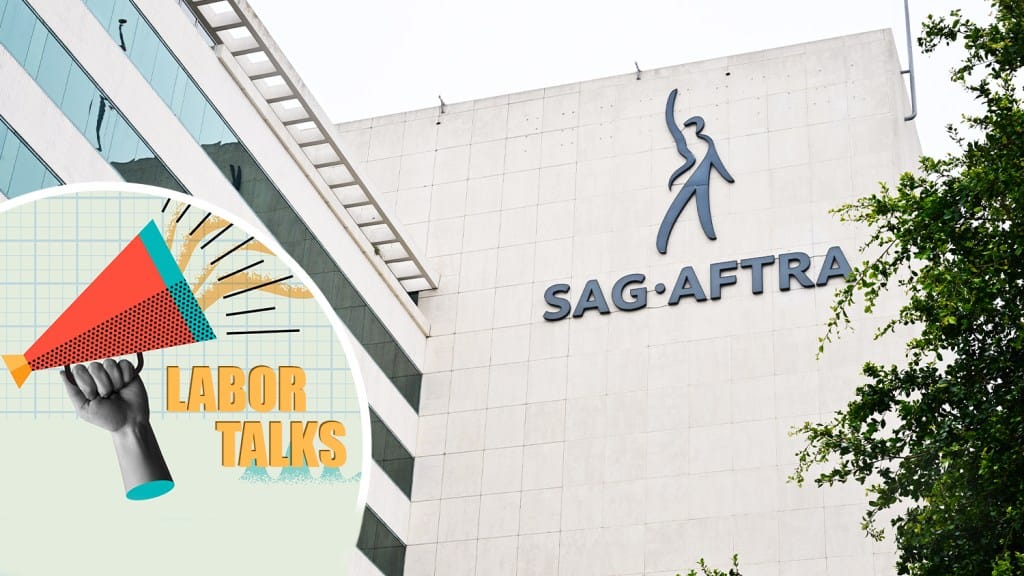
Per Deadline, SAG-AFTRA resumes negotiations with the AMPTP — the alliance that bargains on behalf of the major studios — on Monday, April 27. The union's contract expires June 30. Management begins Directors Guild talks May 11. The window is two weeks.
The WGA closed a four-year deal in roughly three weeks last month. SAG-AFTRA won't. Per Deadline, chief negotiator Duncan Crabtree-Ireland has made airtight AI protections a prerequisite for a longer deal, and the two sides couldn't bridge that gap before talks broke off. Writers don't have their faces and voices used as AI training data; actors do, which makes this a structurally harder negotiation. The leverage point nobody's discussing: per Deadline, the WBD merger terms include a 25-cents-per-share "ticking fee" paid to shareholders each quarter past September 30 if the deal hasn't closed. A strike right now would be catastrophic for Paramount's timeline — which means actors walk into Monday's room with more leverage than the mood suggests. Watch for a front-loaded deal that trades immediate concessions for labor peace through the regulatory window.
David Ellison Promised Theaters a 45-Day Window — and That Was a Very Loud Message to Streaming
Per Variety Australia, Ellison told CinemaCon that Paramount films will get 45 days in theaters before moving on, followed by a three-month paid video-on-demand window before landing on Paramount+. He also committed to a minimum of 30 releases a year.
Release windows are really about who gets paid first and who gets trained to wait. By putting an actual number on theatrical exclusivity, Ellison is telling exhibitors that Paramount wants to be treated as a studio partner rather than a streaming app with a red carpet — and telling rival studios they'll need to answer. If Disney, Universal, or the Netflix-Sony axis matches it, we have a new industry baseline. If they don't, Ellison has publicly handed theater owners a commitment he'll be measured against every quarter. Watch the next major Disney or Universal release calendar for window language.
⚡ Netflix Is Testing Whether *Stranger Things* Can Live Forever — and the First Answer Is Rough
Stranger Things: Tales From '85, Netflix's spinoff designed to extend the franchise past the main show's finale, is receiving sharply negative early community and critical reaction. Reaction threads are running sharply negative — one widely-shared early review called it "a transparent attempt to preserve Stranger Things in pixels rather than amber." (Note: this is community signal and early critical reaction, not Nielsen data, which won't surface for another week.)
The business stakes are real. The Stranger Things theatrical finale earlier this year earned between $25 and $28 million at the box office, per earlier Variety reporting — proof the audience still exists for the right event. A spinoff without the Duffer Brothers at the wheel is a different proposition, and every streamer currently developing a universe extension is watching. If Tales From '85 still drives retention despite the reviews, Netflix will declare victory and the IP-extension playbook spreads industrywide. If engagement cratering follows the reviews, there's a ceiling on how far any streamer can stretch owned IP without the original creative team — and that reshapes development slates at Amazon, Disney+, and Max for years.
⚡ What Most People Missed
- Disney is deliberately starving its own streaming service. Zootopia 2 is approaching $1 billion globally but per reporting compiled this week, Disney is keeping it off Disney+ well into 2026 to extract more theatrical and PVOD revenue first. Combined with Disney+'s new ad-supported tier launch in Australia and New Zealand at AUD 9.99/month, per Variety Australia, it's the same company running two strategies: harvest cash from tentpoles now, build long-term ad revenue from everything else.
- CBS said the quiet part out loud about late night. Per Variety Australia, Paramount TV Media chair George Cheeks explained that CBS is replacing The Late Show With Stephen Colbert — which ends May 21 — with Byron Allen's Comics Unleashed via a one-year time-buy because it delivers "immediate profitability." Once one executive uses that phrase on the record about a legacy prestige slot, half the town starts taking notes.
- The Beef earbud story is a production-economics tell. Per widely-circulated interview coverage, Netflix spent significantly in post-production digitally removing earpieces that Oscar Isaac and Carey Mulligan wore on set for Beef Season 2. It's one anecdote, but it's catching fire because it reads as emblematic — and expect "unauthorized personal electronics" clauses to start showing up in contracts, possibly as SAG-AFTRA bargaining fodder.
- Sony's "neutral studio" strategy keeps looking smarter. Sony never built a consumer streaming platform. Instead, per Variety and Deadline's January reporting, it locked in a $7 billion-plus global Pay-1 deal with Netflix — the first of its kind at worldwide scale. While Paramount and WBD take on roughly $80 billion in combined debt to build a streamer, Sony is collecting a check and going back to making movies.
- A billion-dollar blue alien validated the theatrical pivot. Disney's live-action Lilo & Stitch crossed $1 billion globally after executives shifted it from a streaming-first release to a full theatrical run — a reminder that theatrical can still build the cultural event that amplifies downstream streaming value, not just opening-weekend receipts.
📅 What to Watch
- If California AG Rob Bonta files a formal challenge to the merger, the deal moves from "regulatory formality" to a multi-year state-court fight that could force divestitures Paramount hasn't planned for.
- If SAG-AFTRA talks break off a second time before May 11, the DGA goes first and actors drop to the back of the line with a June 30 expiration — raising real strike risk during Paramount's regulatory window.
- If Netflix's Q1 earnings next week show flat churn after the March price hikes, it confirms the pricing ceiling is higher than anyone thought on the quarter — and every other streamer will face pressure to raise prices within two quarters.
- If Disney or Universal matches Ellison's 45-day theatrical window in a public commitment, we have a new industry baseline and the streaming-day-and-date experiments of 2021–2023 are formally dead.
- If Tales From '85 viewership holds despite the reviews, Netflix will green-light more spinoffs — and every other streamer will accelerate universe-extension development regardless of original-creator involvement.
- If Moody's downgrades Paramount's debt to junk before the close, the combined company starts life with meaningfully higher borrowing costs — and the $6 billion in "cost savings" becomes a layoff number, fast.
The Closer
A ten-minute shareholder meeting, an $887 million goodbye nobody voted for, and a CEO eating dinner at a Washington event honoring President Trump the same night his creative community called him a threat to democracy. Somewhere in a Netflix edit bay, a VFX artist is painting earbuds out of Oscar Isaac's head frame by frame, and that is the single most honest image of prestige television in 2026.
Back next week. Forward this to the friend who keeps asking you what's actually happening with the Paramount thing.