Robotics & Automation Weekly — May 10, 2026
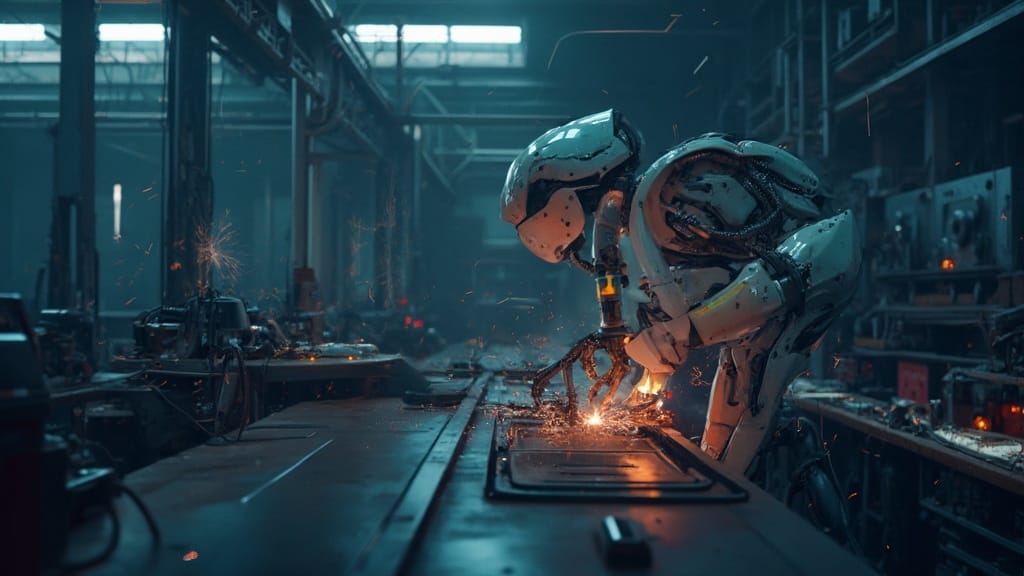
Photo: throughlineintelligence.com
Week of May 10, 2026
The Big Picture
The humanoid story finally has numbers worth arguing about — Figure AI claims one robot per hour off its BotQ line at 80%-plus first-pass yield, Boston Dynamics is reportedly stuck at four Atlas units a month against a 30,000-a-year target, and Agility's Digit just converted a year-long Toyota pilot into a paid commercial contract for seven units. Underneath the humanoid theater, the industrial middle layer is moving: Rockwell raised guidance and filed permits for a million-square-foot Wisconsin site, Cognex booked a 24% revenue jump in Q1 2026 year-over-year, and a no-reserve auction in Warren, Ohio is dumping 150-plus FANUC, ABB, KUKA and Yaskawa robots to make room for incoming inventory. The reshoring announcements are real; the workforce, the regulatory baseline, and the insurance market underneath them are not yet ready.
What Just Shipped
- In-Sight 6900 Vision System (Cognex with Nvidia): edge-AI machine vision system highlighted in Cognex's Q1 2026 results, reporting revenue up 24% year-over-year.
- In-Sight 3900 Vision System (Cognex with Qualcomm): companion edge-vision launch targeting on-line inspection at the controller layer.
- AEON Humanoid (Hexagon Robotics with Fill Maschinenbau): bipedal platform now deployed at Fill's Austrian production environments for machine tending and inspection, using Nvidia Isaac GR00T training and Hexagon Reality Cloud Studio for digital-twin integration.
- Data Factory 1 (Tutor Intelligence): a 100-robot facility opened May 7 in Watertown, Massachusetts, dedicated to generating training data for unstructured manipulation tasks.
- Carter AMR (Robust.AI): collaborative mobile robots now in commercial deployment under a five-year DHL Supply Chain alliance, expanding into Mexico with 15 units in retail logistics.
This Week's Stories
Figure AI Says BotQ Is Building One Humanoid an Hour at 80%-Plus Yield
Figure AI is now building one humanoid robot per hour at its California BotQ facility — a 24-fold ramp over four months — and reports first-pass yield above 80% on the line, per coverage citing Interesting Engineering. The company says it has delivered more than 350 robots, with BMW running them at Leipzig and Spartanburg on body-shop tasks like trim panel insertion, and prices the Figure 03 at roughly $30,000 a unit.
The yield number is what makes this different from the usual humanoid press cycle. Throughput claims are easy to inflate; first-pass yield is a manufacturing quality metric that flows into rework, scrap, and warranty data, and it's hard to fake at scale. If the figure replicates under independent measurement, it's the first time the humanoid ROI math has plausibly closed for someone other than a flagship automotive OEM. If it doesn't — if those units come back with high field-failure rates or if BotQ output stalls below the published cadence — Figure becomes a cautionary tale about the gap between assembly throughput and operational reliability. Watch for an independent audit, a customer-disclosed MTTF figure, or a second customer naming Figure on a production-critical station. Single-source caveat applies; this is a vendor-adjacent claim until it isn't.
Hyundai's Atlas Math Problem: 4 a Month, 30,000-a-Year Target
Hyundai's plan for the Metaplant near Savannah, Georgia is to build 30,000 Atlas humanoids a year by 2028 and deploy them across its global facilities, starting at the Ioniq 5 and Ioniq 9 lines. According to autobroadcast.com's reporting, Boston Dynamics is currently making about four Atlas robots per month while it works out large-scale manufacturing — and that production gap has reportedly contributed to executive turnover.
Four a month is 48 a year. The target is 30,000. That's a 625x ramp in roughly 24 months, on a robot whose first production task will be parts sequencing — making sure components land in the right spot when the line calls for them — with more complex assembly slated for 2030. Spot, the four-legged sibling, is already running vehicle inspections at the Metaplant. The credible signal will be a third-party-verified unit count or uptime metric from Savannah. Until then, the roadmap is a roadmap, and the production line is the production line.
Agility's Digit Converts a Toyota Canada Pilot to a Commercial RaaS Contract
Agility Robotics signed a Robots-as-a-Service agreement with Toyota Motor Manufacturing Canada in February 2026 to deploy seven Digit humanoids at the Woodstock, Ontario RAV4 plant, following a year-long, three-phase evaluation involving development, proof-of-technology, and an onsite live pilot. The robots are doing tote and bin movement in logistics areas adjacent to the assembly line — exactly the task where bipedal mobility in human-built aisles earns its keep.
The structure matters more than the unit count. TMMC is Toyota's largest manufacturing operation outside Japan, and Toyota's IATF 16949 quality regime does not advance technology through production gates on hype. A pilot converting to a paid commercial contract under that scrutiny is the strongest deployment-validation signal in the humanoid market right now. The RaaS structure also tells you what's not yet true: Toyota is buying throughput, not the asset, which means Agility carries the uptime risk. If the fleet expands beyond seven units and a second automotive OEM signs a similar contract before year-end, this is a repeatable model. If it stays at seven and quietly recedes, it was a well-engineered pilot. The number of Digit units in Woodstock twelve months from now is the test.
DHL and Robust.AI Lock In Five Years of Carter AMRs Across the Americas
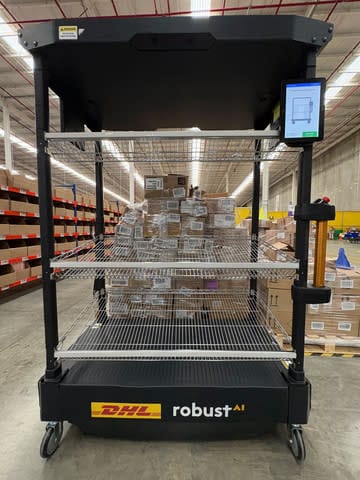
DHL Supply Chain announced a five-year strategic alliance with Robust.AI to deploy Carter collaborative mobile robots, starting with 15 units in retail operations in Mexico after successful North American deployments, per Modern Materials Handling. The performance gap inside the announcement is the part worth dwelling on: Carter has improved productivity by over 60% in North American facilities and roughly 30% in Mexico so far.
Same robot, different result. The delta appears to reflect differences in warehouse management system integration maturity, slotting strategy, and the operational tribal knowledge that takes months to build. DHL plans to deploy hundreds of Carter units across the Americas, with other regions under review. A five-year contract with a 3PL at DHL's scale is the kind of commercial signal that validates a robotics platform far more than any trade show demo. Watch whether the Mexico productivity gap closes as WMS integration matures — that's the real test of whether RaaS economics travel across operational environments, and it's the question every multinational logistics operator is now asking.
Rockwell Raises Guidance, Files Permits for a Million-Square-Foot Wisconsin Site
Rockwell Automation raised its fiscal 2026 outlook to roughly $8.9 billion in sales at the midpoint and is guiding 5%–9% organic growth for fiscal 2026, with the Intelligent Devices segment up mid-teens in the quarter. On April 7, the company filed permits to advance a New Berlin, Wisconsin project planned at roughly one million square feet of manufacturing and warehouse space — concrete-and-permit evidence rather than press-release reshoring.
Two signals here, and they're related. The earnings update says manufacturers are still buying automation where ROI is clear, but they're being selective — pockets of spending, not a blanket boom. The permit filing says Rockwell itself is putting capital behind a U.S. footprint expansion that will eventually pull through controls, motion, and safety orders. If other major automation suppliers — Emerson, Schneider, Siemens — echo the selective-capex pattern in their own quarterly numbers, the "capex is back" story broadens from anecdote to trend. The number to watch is whether Intelligent Devices growth holds into Q3.
Cognex Reports Its Cleanest "We're Back" Quarter in Years
Cognex reported Q1 revenue up 24% year-over-year to about $268 million and rolled out two new edge-AI vision platforms — In-Sight 6900 with Nvidia and In-Sight 3900 with Qualcomm — pushing inspection compute to the line rather than the server room. (The SEC-hosted version of the release was on a content-mismatched URL; we're flagging it unlinked here for source integrity.)
Machine vision tends to be a leading indicator for factory automation budgets. Inspection adoption directly reduces scrap and protects yield, which is why it gets approved before larger automation projects clear capital review. A 24% growth quarter combined with a hardware refresh that puts AI inference on the line is the kind of combination that pulls more robotic-cell orders behind it. The signal to watch is whether Cognex starts naming customers with disclosed false-reject or yield numbers in upcoming quarters — that's when vision crosses from product launch to operating leverage in someone else's factory.
Reshoring's Real Bottleneck Isn't Tariffs — It's Operational Readiness
Seraph's analysis this week makes a useful distinction: policy uncertainty is the trigger for reshoring decisions, but operational unreadiness is the binding constraint. Mexico's industrial sector contracted 1.1% across 2025 despite record FDI inflows, manufacturing PMI stayed in contraction territory through Q1 2026, and Tesla's and BYD's flagship Mexican gigafactory plans appear to have stalled. Bloomberg separately tracks roughly $7 trillion in "pending" projects that companies have planned but not committed.
Fortune sharpened the same point from a different angle: a factory's limits are cognitive as well as physical. Quoting, process planning, scheduling, setup, and inspection still live inside experienced operators' heads, and reshoring at scale requires extracting that knowledge into systems that less-experienced workers can run. Deloitte and the Manufacturing Institute project 3.8 million manufacturing jobs needed over the next decade and 1.9 million potentially unfilled, with 2.8 million openings driven by retirement, per Stock Investor's reporting. Mitsubishi's 2026 supply-chain analysis adds the harder rule: products that cannot be produced with at least 60–70% automated processes may still be priced out of domestic labor. The signal that separates real reshoring from theatrical reshoring is utility hookup filings, equipment orders, and employer-sponsored automation technician training tied to specific facilities.
⚡ What Most People Missed
- A no-reserve auction in Warren, Ohio is dumping 150+ industrial robots to make room for "incoming inventory." BTM Industrial helped liquidate FANUC, ABB, KUKA and Yaskawa units — including a FANUC M-2000ia/1200 with an estimated $400,000-plus replacement cost — at a no-reserve sale held May 5–6. President Jeff Orlowski cited speed and floor space for incoming inventory. Mahoning Valley is one of North America's densest robot integration corridors; if a single supplier is clearing 150 production-grade units to stage new iron, that's a capex cycle signal that will surface in OEM order books in 6–12 months.
- The "absolute AI exclusion" is now showing up in industrial insurance policies. A Roots.ai industry report describes major carriers — Berkley among them — introducing absolute AI exclusions across Directors & Officers and Errors & Omissions lines, with secondary markets including Munich Re writing standalone AI-liability and robotics policies to fill the gap. For integrators and mid-market end users, risk transfer for autonomous decision-making increasingly requires a separate insurance product. This is the financial expression of the OSHA gap, and it's moving faster than the standards bodies.
- OSHA still has no robot-specific standard, and humanoids are about to make that gap dangerous. OSHA's own page confirms there are no specific standards for the robotics industry; enforcement runs through the General Duty Clause. Most robot accidents historically occur during programming, maintenance, or setup — when workers are inside the envelope. Now layer in AEON, Digit, and Atlas operating in shared aisles without hard guarding. The first serious humanoid-related injury in a non-celled environment will trigger enforcement action, and there is currently no industry-consensus standard to defend against it. ISO 10218-1:2025 raises the documentation bar but does not close the workspace gap.
- Two labor agreements quietly redrew the automation map this week. DHL Teamsters ratified a four-year contract on May 5 that prohibits autonomous vehicles threatening driver jobs and adds protections around algorithmic dispatch. Separately, UAW Local 1700 at Stellantis Sterling Heights authorized a strike vote on May 7–8 over outsourced skilled-trades work — a jurisdictional fight over who installs, maintains, and programs automation. Neither is a robot ban; both are integrator and maintenance bottlenecks that can slow retooling cycles materially.
- Chinese precision-reducer forecasts are flashing supply-chain red. One QY Research forecast projects the humanoid precision-reducer market growing from roughly $175 million in 2024 to about $13.6 billion by 2031; a unified precision-reducer view puts the broader market near $4.49 billion by 2031 at a ~15.9% CAGR. Reducers are a component-level choke point — if even a fraction of those numbers materialize as orders, harmonic-drive lead times become the constraint on every humanoid OEM's production ramp. [Source: QY Research / Global Research — Japanese]
- UPS is automating its way to 68% of U.S. volume through automated facilities by year-end. Per Techai News Today, UPS has automated 127 buildings and is targeting that two-thirds threshold by year-end. When the second-largest parcel carrier in the world commits to running most of its volume through automated sites, that's a structural shift in demand for sortation, AMR, and conveyor equipment — not a trend.
📅 What to Watch
- If a second automotive OEM converts a humanoid pilot to a paid commercial contract before year-end, the Toyota Canada deployment becomes a template for procurement rather than a TMMC anomaly — and RaaS pricing becomes the default structure.
- If Figure's 80%-plus BotQ yield gets corroborated by an MTTF disclosure or independent audit, the humanoid ROI math closes for mid-market manufacturers, not just flagship OEMs — and the price floor on industrial humanoids drops faster than reducer suppliers can scale.
- If Grimes County advances SpaceX's Terafab tax-abatement process at its June meeting, it pulls forward demand across wafer handling, metrology, and cleanroom robotics in a way that compresses lead times for fab-tier automation suppliers nationally.
- If a major harmonic-drive maker discloses backlog or capacity expansion in the next two quarters, the precision-reducer forecasts move from speculation to constraint — and humanoid OEMs without locked supply contracts get rationed.
- If OSHA opens a General Duty Clause action involving a humanoid or AMR in a non-celled workspace, every workers-comp underwriter repricing automated facilities accelerates the absolute-AI-exclusion trend, and integrators carry more residual risk.
- If the Mexico Carter productivity gap closes toward the 60% North American figure within the contract's first year, it proves WMS integration — not robot capability — is the rate-limiter on global AMR rollouts, which changes how every 3PL sequences its automation roadmap.
The Closer
Four Atlases a month rolling out of a factory chasing thirty thousand a year, a Warren, Ohio auctioneer hustling 150 robots off the floor before the new ones arrive, and an insurance underwriter quietly stapling an "absolute AI exclusion" onto a D&O policy for a warehouse where a humanoid is about to start its shift. The robots are getting cheaper, the yield curves are getting steeper, the lawyers are getting faster — and OSHA still doesn't have a rule for any of it.
Until next week — keep an eye on the permit filings, not the press releases.
If you know an operations lead, an integrator, or anyone whose week is about to be reshaped by a humanoid, a reducer shortage, or a labor clause — forward this to them.