Blueprint — Apr 21, 2026

Photo: lyceumnews.com
Past 2 Weeks — April 21, 2026
The Big Picture
The trades aren't getting louder this month — they're getting earlier. Michigan just funded career and technical education for 12-year-olds; the Department of Labor rewired its apprenticeship grants to pay states for growth instead of participation, and National Apprenticeship Week moved to spring for the first time — landing next week, right in the middle of your decision-making window. If you've been waiting for someone to hand you a map, the last two weeks are as close as it gets.
What Just Shipped
- $85M State Apprenticeship Expansion Formula Grants, Round 4 (U.S. Department of Labor): Performance-based formula that rewards states for growth in active and new apprentices, with a public push toward 1 million apprentices nationwide.
- Michigan 61v CTE Expansion Grants (Michigan Department of Education): $24.2M to 56 districts funding 46 new middle school and 41 new high school CTE programs.
- DENSO Manufacturing Michigan Skilled Trades Apprenticeship Class of 2026 (DENSO): Graduated its largest-ever cohort — 11 apprentices — through a DOL Registered Apprenticeship in industrial maintenance and controls.
- National Apprenticeship Week 2026 (U.S. Department of Labor): First spring NAW, April 26–May 2, themed "America at Work," with events targeting skilled trades, advanced manufacturing, shipbuilding, and nuclear energy.
- Colorado Apprenticeship Career Expo (Colorado Department of Labor and Employment): April 28 in Denver — registered apprenticeship and pre-apprenticeship programs on-site for walk-up conversations with students.
This Week's Stories
The Trade That Runs Everything You Can't See — Pipefitter, Explained
You've heard of plumbers. You've almost certainly never heard anyone explain what a pipefitter does — and that gap is exactly why this career is interesting.
Pipefitters install and maintain the high-pressure systems that move steam, chemicals, gases, and fluids through industrial plants, hospitals, power stations, and commercial buildings. The Bureau of Labor Statistics classifies them alongside plumbers and steamfitters, but the work scales up: reading blueprints, threading and welding pipe, pressure-testing systems, and connecting the guts of buildings most people never enter. The BLS notes pipefitters typically complete an apprenticeship and pass a licensing exam to work independently.
The pay range is wide and depends heavily on whether you go union. According to Glassdoor, the average union pipefitter earns $92,250 per year — roughly $44/hour — with top earners above $152,000. Non-union pipefitters, also per Glassdoor, typically land between $65,691 and $100,838. That $20K–$30K union premium is before health insurance and pension.
What changes if this path works for you: you earn while you learn for five years, finish debt-free, and hit six figures in major metros by your late 20s. What failure looks like: you pick a non-union shop with bad safety culture, burn through your knees by 45, and never build the network to move into foreman or estimator work. Signal to watch: whether your local United Association chapter (find it at ua.org) opens a window this spring — most do once or twice a year, and competitive metros fill fast.
A California Contractor Just Got Hit With a $468K Wage Theft Fine — Read This Before Your First Job
A federal investigation found a California contractor shorted workers on overtime, missed payroll, and retaliated against employees who complained — resulting in a $468,000 back-wages order, reported by Construction Dive citing the U.S. Department of Labor probe.
You will hear "pick a good employer" a thousand times before you start. This is what a bad one actually looks like on paper. In non-union construction especially, your first boss determines whether your first-year paycheck matches what you were promised or whether you spend Sundays calculating unpaid overtime.
What changes if enforcement keeps climbing: smaller shady operators get priced out, and reputable non-union shops benefit. What failure looks like: enforcement stays spotty, and workers absorb the losses quietly. Signal to watch: whether the DOL publishes more back-wages actions in construction over the next 90 days — and whether your state labor department posts a searchable violations database. Before you sign with any contractor, look them up. Union Joint Apprenticeship Training Committees screen employers; that's one of the things you're buying when you go union.
Electrician Pay Still Tells the Clearest Story in the Whole Debate
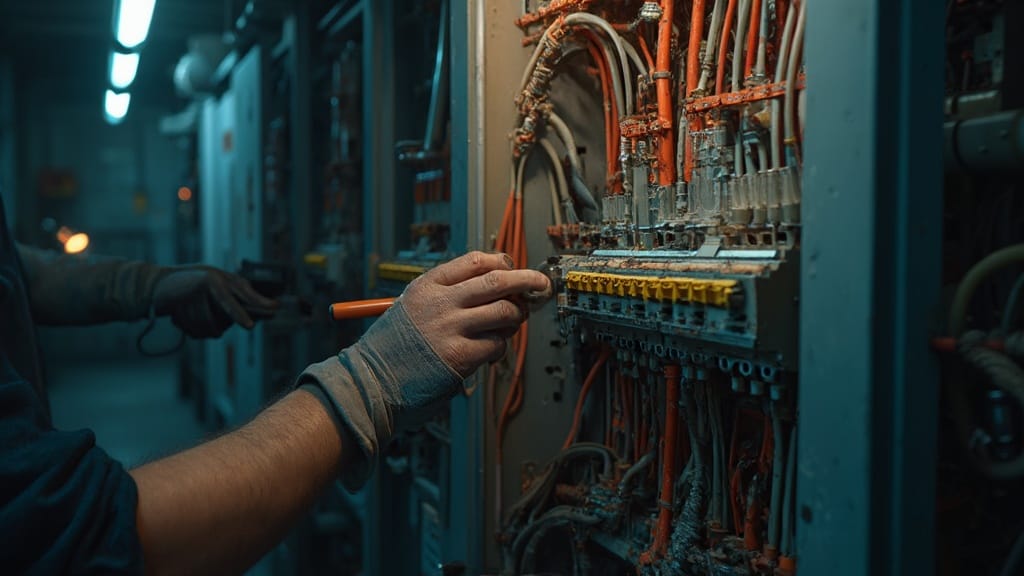
Here's a real number from a real source. The Bureau of Labor Statistics reports electricians earned a median annual wage of $62,350 in May 2024, with the top 10% above $106,030 — and projects 9% employment growth from 2024 to 2034, faster than average.
The part people skip is the timeline. Most electricians train through a 4- or 5-year apprenticeship with about 2,000 hours of paid on-the-job training each year plus classroom instruction, per BLS. Year one is pulling wire, carrying material, and getting corrected a lot. By year five you're someone a foreman trusts with a real problem. After that, the ceiling rises again — service lead, estimator, project manager, contractor, owner.
To see how benefits rewrite the picture, look at a real local package. IBEW Local 48 in Portland posted its 2026 journey-level rate at $65.50/hour in gross wages plus $33.24 in employer-paid fringe benefits — a total package near $96/hour. Some of the value never shows up on your paycheck but is still being spent on you.
What changes if you get in: your first decade out-earns most of your college-bound classmates, with zero debt. What failure looks like: you bomb the IBEW aptitude test because you didn't realize it weighs algebra heavily, and you wait a year to reapply. According to the Boston JATC, thousands apply for limited slots and many programs require proof of at least a year of algebra with a C or better. Signal to watch: your local JATC's next application window — treat it like a deadline.
The Elevator Mechanic Window Is Tiny — and That's Exactly Why You Should Know How It Works

Elevator mechanic is one of the highest-paid trades almost nobody at your school can explain — and the path in doesn't work like "apply anytime." It works like sneaker drops.
The National Elevator Industry Educational Program runs the training, and local recruitments are the formal entry point. Per NEIEP, recruitments typically happen every two years; applicants take an aptitude test covering math, mechanical comprehension, and reading, then get ranked. Companies hire down that list. You can apply at 17 but must be 18 to register. The apprenticeship is four years.
The BLS Occupational Outlook Handbook lists elevator installers and repairers among the highest-paid construction occupations. ZipRecruiter data puts union elevator mechanics near $130,000 nationally, with top earners in major cities above $160,000. The tradeoff: heavy lifting, cramped shafts, and regular work at heights.
What changes if you catch a window: you're in one of the most structured, highest-paid apprenticeships in the country. What failure looks like: you hear about it after the window closes and wait two years. Signal to watch: your regional NEIEP recruitment page. Gather transcripts and start practicing mechanical aptitude questions now, not when the window opens.
Welding Pay Is Wider Than the Headlines Suggest
Per GoTradeSchools' 2026 welder guide, apprentices typically start at 40–50% of journeyman wages — roughly $14–$19/hour — and step up each year. Certified journeyman welders in standard shop environments earn $45,000–$65,000. Specialize in pipeline, pressure vessels, underwater, or aerospace work and the ceiling moves significantly.
The certification ladder is what separates a $20/hour welder from a $40/hour one. American Welding Society certifications test specific processes (MIG, TIG, stick) and positions (flat, vertical, overhead). Each one expands the jobs you can bid on. Pipeline welding, which requires extended remote stretches outdoors, routinely pushes total annual compensation past $100,000 with overtime — at the cost of weeks away from home.
The path in is unusually flexible. Per GoTradeSchools, trade school certificates run 6–12 months and cost $3,000–$10,000; associate degrees run two years at $8,000–$20,000; apprenticeships run 3–4 years and cost as little as $135 out of pocket because you earn the whole time. Manufacturing Dive reports Rocky Mountain Steel plans to operate a new long-rail mill in Pueblo, Colorado this year as part of a $1 billion investment — the kind of regional buildout that creates sustained structural welding demand.
What changes if you stack certs: your wage climbs with each one, not with seniority alone. What failure looks like: you finish a certificate program and never add a second cert, capping your pay at the low end of the range. Signal to watch: whether shipyard and mill expansions in your region post openings requiring specific AWS certs — that tells you which ones to chase.
The DOL Just Changed How $85M in Apprenticeship Money Gets Handed Out
On April 13, the U.S. Department of Labor announced roughly $85 million in the fourth round of State Apprenticeship Expansion Formula grants — with a performance-based formula that rewards states for recent growth in active and new apprentices and requires them to publish average program approval times.
Earlier rounds paid states to run programs. This round pays them to grow programs. States have to set statewide expansion goals, reserve funding to directly support employers in priority industries, and make approval timelines transparent.
What changes if states actually deliver: more seats open in fast-growing states, approval times shrink, and employer-sponsored cohorts like DENSO's become the norm rather than the exception. What failure looks like: states collect the money, report growth on paper, but the underlying data systems can't verify it — a concern that New America, Third Way, and Mathematica have all flagged as the binding constraint on youth apprenticeship quality. Signal to watch: your state's apprenticeship dashboard and the DOL funding opportunities page over the next 30–90 days for new sponsor announcements.
Michigan Is Pushing CTE Into Middle School — and Putting $24M Behind It
On April 8, Michigan announced $24.2 million in CTE expansion grants to 56 school districts, funding 46 new middle school programs and 41 new high school programs. Per the Michigan Department of Education, over $2.5 million specifically targets middle school CTE exposure — a first for the state and something most states still do not offer.
Daily Press reporting on the Upper Peninsula rollout frames the logic directly: historically, CTE has been a high school program, and the state is now trying to build a seamless path from middle school exploration to high school training and credentialing to postsecondary and career. The state reports CTE programs have grown 44% over the past decade, and a second funding round is expected.
What changes if middle-school CTE works: by the time a student is 17, "plumber" or "millwright" isn't an exotic suggestion — it's a path they've already touched. What failure looks like: programs launch without the linked K-12-to-workforce data systems needed to prove they change outcomes, and the funding dries up in three years. Signal to watch: whether other states — especially ones chasing the new DOL performance dollars — copy the middle-school piece.
⚡ What Most People Missed
Wind turbine technicians are projected to grow about 50% from 2024 to 2034, per BLS data cited in Ken Rusk's 2026 ROI analysis. That makes it one of the fastest-growing trades in the country, and almost no high school student has it on their radar. Entry is usually a two-year technical program or military background; pay starts around $25/hour and climbs quickly.
About 40% of degree holders work in jobs that don't require a college degree, per thebirmgroup.com's 2026 analysis. The underemployment number almost never shows up in the college-vs-trades debate, but it's the most important data point for anyone considering a general degree without a clear career target. The question isn't "trades or college" — it's "which specific job, and what's the cheapest, fastest path?"
An 18-year-old HVAC install apprentice posted the honest version of the pipeline on Reddit this week — full-time work through a high school co-op, hot attics and crawlspaces, and a proposed in-house training path tied to a three-year contract with a possible $30,000 clawback. One social post isn't evidence, but it's a useful signal: the trade-vs-college pitch is reaching students faster than the guidance ecosystem is catching up. If a contractor offers "free training," ask whether there's a repayment agreement and what triggers it.
📅 What to Watch
- If your state's apprenticeship dashboard starts publishing program approval times, it means the DOL performance formula is biting — and the states that move fastest will have more open seats this fall.
- If more employers follow DENSO's model and publicize their own apprenticeship cohorts, the center of gravity shifts from union JATCs toward company-run programs — which pay differently and bind you differently, so read the contract.
- If NEIEP or IBEW locals in your metro post recruitment windows during National Apprenticeship Week, assume they'll close fast — the spring timing exists specifically to catch you before you commit elsewhere.
- If BLS metro-area wage data shows the union/non-union gap widening in your region, that's a stronger argument for the union path than any national average, because national averages bury the local number that actually determines your life.
- If your state passes apprenticeship-to-college-credit legislation (New Jersey and Massachusetts already have versions), the hybrid path — trade first, degree later while working — becomes materially cheaper.
- If contractor wage-theft enforcement actions keep climbing after the $468K California case, vetting small shops through DOL records becomes table stakes, not paranoia.
The Closer
A $468,000 wage theft fine, an 18-year-old in a Carolina attic reading the fine print on a $30,000 clawback clause, and the U.S. Department of Labor quietly rescheduling its biggest week of the year to ambush you before you sign a college deposit. Somewhere a guidance counselor is still handing out a pamphlet that says "have you considered community college?" while Michigan is teaching seventh graders to run a conduit bender. Go find your local JATC window before it closes.
Forward this to the friend whose parents keep asking about their "plan."